



💛 A quick favor, if you've got a second.
We're really happy that you chose to read one of our stories and sincerely hope you'll stick around to read more. We took our paywall down — for now — but that won't last forever, and when the gate goes back up, we'd love for you to already be on the inside.
It's free. So please enter your email here and don't forget to like and follow us on all of your favorite Social Media platforms!
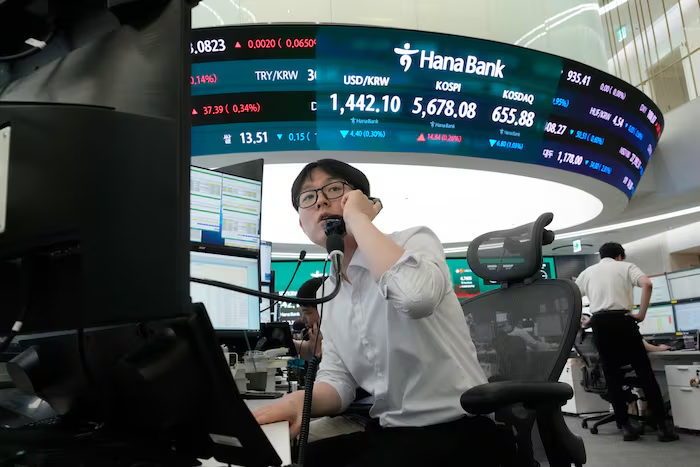
Crude oil retreated Wednesday while most Asian equity markets moved lower, extending a volatile stretch that has roiled semiconductor stocks across the region. South Korea’s Kospi benchmark extended its recent downward trajectory, having shed more than 16% over the previous two trading sessions amid concerns about technology companies’ massive spending on artificial intelligence infrastructure.
The Kospi swung between gains and losses Thursday, finishing down 1.3% at 5,587.82 after declining 10.8% Tuesday and nearly 6% Wednesday. The index has retreated more than 35% from its June peak above 9,000 points, though it remains approximately 30% higher than its level at the start of the year, reflecting lingering optimism tempered by recent skepticism over AI-related capital expenditures.
Samsung Electronics rose 2.4% Thursday following release of record quarterly operating profits that aligned with analyst estimates. By contrast, SK Hynix declined 4% despite reporting record operating earnings that nearly sextupled year-over-year, as the results fell short of market expectations and triggered share sales.
Japan’s Nikkei 225 gained 0.6% to 61,778.02, with Tokyo Electron climbing 4.4% and Kioxia Holdings adding 7.5%, offsetting a 2.7% drop by SoftBank Group. Taiwan’s Taiex advanced 0.8%, with chipmaker TSMC climbing 1.8%, while Hong Kong’s Hang Seng slipped marginally to 25,779.70 and Shanghai’s composite index fell 1.2% to 3,784.55.
Crude benchmarks declined despite renewed U.S.-Iran military exchanges. Brent crude fell 1% to $87.18 per barrel, down sharply from roughly $72 in late February before Middle East hostilities intensified. U.S. benchmark crude dropped 0.9% to $83.74 as restricted maritime traffic through the Strait of Hormuz pressured global supply calculations.
President Donald Trump indicated the U.S. would strike Iran “very hard” following an attack on a U.S. military base in Jordan, while the State Department announced it had conducted a heavy wave of strikes against Iranian targets early Thursday. Oil market volatility persists as geopolitical risks offset supply concerns.
Wall Street declined Wednesday ahead of the Federal Reserve’s policy decision. The S&P 500 dropped 1.5% to 7,316.15, the Dow Jones Industrial Average fell 2.2% to 51,594.14, and the Nasdaq composite lost 1.7% to 24,442.94, with major semiconductor stocks taking particular losses including Nvidia down 3.6%, Advanced Micro Devices down 5.5%, and Broadcom down 2.8%.
The Federal Reserve maintained interest rates steady despite some committee members advocating for increases. Chairman Kevin Warsh emphasized the central bank’s commitment to returning inflation to its 2% target while signaling reduced forward guidance on future policy moves, a shift likely to amplify market volatility amid heightened uncertainty.
In currency markets, the U.S. dollar strengthened to 163.49 Japanese yen from 163.41, while the euro weakened to $1.1454 from $1.1467. The 10-year Treasury yield climbed to 4.70% from 4.61% late Tuesday.


More Stories
Looney Tunes’ ‘Coyote vs. Acme’ Debuts With $15.5 Million as ‘Spider-Man’ Holds Box Office Crown
Trump Calls NASA to Congratulate Agency on Roman Space Telescope Launch
Meta Ordered to Implement Sweeping Teen Safety Restrictions Under Settlement