



💛 A quick favor, if you've got a second.
We're really happy that you chose to read one of our stories and sincerely hope you'll stick around to read more. We took our paywall down — for now — but that won't last forever, and when the gate goes back up, we'd love for you to already be on the inside.
It's free. So please enter your email here and don't forget to like and follow us on all of your favorite Social Media platforms!
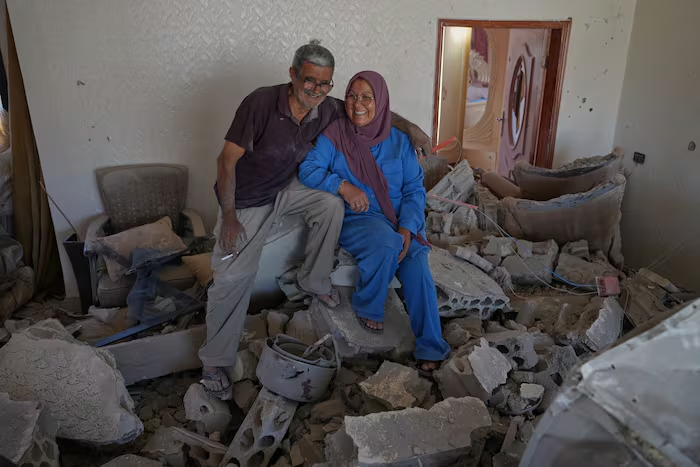
Mahasen Faqih and her husband ventured back to their destroyed home in Zawtar al-Gharbieh this week, sifting through rubble as part of a U.S.-mediated accord in which Israel committed to pullback from southern Lebanon in exchange for the disarmament of the Iran-backed Hezbollah organization. The couple had fled northward shortly after the conflict erupted in early March, leaving behind a residence now rendered uninhabitable by extensive damage. They have chosen to temporarily reside in their village grocery store while awaiting demolition and reconstruction of their primary dwelling.
The 58-year-old Faqih expressed determination to remain despite the devastation, stating that staying in their community represents a symbolic stand against displacement. According to Mayor Abed Ezzeldine, merely 15 families have returned to the village since the Lebanese military assumed control one week prior, though nearly half of the settlement’s 500 homes have been destroyed and many others severely damaged.
Israel’s Defense Minister Israel Katz disclosed Tuesday that the military has razed 24 centuries-old villages and destroyed between 15,000 and 20,000 structures throughout Lebanon. Israeli forces currently control 700 square kilometers of southern Lebanese territory, Katz told a television station, claiming they are safeguarding border communities from militant incursions.
The initial withdrawal agreement has sparked controversy, particularly regarding the selected pilot zones where Israeli troops were not substantially present before the deal, raising questions about the mechanics of any actual withdrawal. In Zawtar al-Gharbieh, Israeli forces occupied adjacent territories and subjected the village to intensive bombardment, preventing residents and Lebanese military personnel from entering until recent days.
Faqih recovered only nine plates from her kitchen during her search through the debris, with major structural damage throughout the residence including a partially collapsed ceiling and a hole created by an Israeli strike in the main bedroom. She indicated she had already spent $20,000 on jewelry sales to fund repairs from earlier 2024 fighting, funds she no longer possesses for ongoing reconstruction efforts.
Mayor Ezzeldine characterized the village as “disaster-stricken,” noting that many standing structures are unsuitable for habitation and cannot be renovated. Lebanese military bulldozers cleared debris from streets while armored vehicles and trucks mounted with machine guns positioned themselves throughout the settlement near a partially destroyed mosque.
Technical delegations from Lebanon and Israel are scheduled to convene in Rome beginning August 4 to discuss additional pilot zones for Israeli military handover to Lebanese control. A Lebanese foreign ministry official confirmed the focus will center on identifying further areas for transition, though Faqih expressed skepticism that gradual village-by-village withdrawal would occur for years.


More Stories
Modern Science Finally Supports & Strengthens Biblical Account of the Crucifixion of Jesus Christ
Federal Prosecutors Convene Special Grand Jury to Investigate D.C. Schools’ Attendance and Graduation Practices
State Department Reissues Level 3 Travel Advisory for Israel Amid Terrorism and Armed Conflict Concerns