


💛 A quick favor, if you've got a second.
We're really happy that you chose to read one of our stories and sincerely hope you'll stick around to read more. We took our paywall down — for now — but that won't last forever, and when the gate goes back up, we'd love for you to already be on the inside.
It's free. So please enter your email here and don't forget to like and follow us on all of your favorite Social Media platforms!
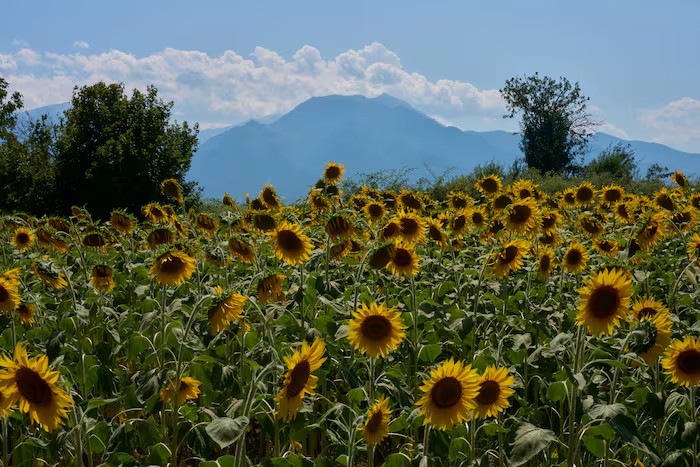
Rising 2,918 meters above sea level with peaks frequently hidden beneath mist and cloud cover, Mount Olympus ranks among the world’s most celebrated mountains. For ancient Greeks, the northern massif represented the sacred dwelling place of Zeus and his divine court, a cultural belief that has shaped Western civilization across millennia.
Greece has initiated a bid to secure formal World Heritage designation for the mountain through UNESCO’s prestigious program. Officials are advancing the nomination by highlighting both the site’s mythological and spiritual dimensions alongside its ecological richness and species diversity. The World Heritage Committee will render judgment on the candidacy during sessions held in Busan, South Korea, beginning Sunday through July 29.
Evagelos Geroliolios, mayor of Litochoro municipality—the primary town serving as access point to the mountain—underscored its significance to the local population. He articulated that residents maintain an intimate connection to Olympus while fully appreciating its archaeological importance, narrative depth, and environmental value.
Classical mythology holds that Zeus claimed the mountain as his seat of power after vanquishing Cronus and ending the Titans’ dominion. Archaeological investigations have uncovered tangible proof of ancient religious activity, including a ceremonial area with relics originating in the Hellenistic period spanning 323 B.C. to 30 B.C.
Ancient writings document that Plutarch chronicled religious pilgrimages up Olympus’s flanks during the second century A.D., where devotees made animal offerings to honor Zeus. Spiritual significance persisted through the Christian period, evidenced by a chapel at Prophet Elias peak that may represent the world’s highest Orthodox Christian place of worship.
The mountain’s spiritual landscape encompasses additional sacred structures, including a 1542 monastery within Enipeas Gorge and a grotto sanctuary honoring Saint Dionysios. These religious locations collectively illustrate sustained reverence spanning different epochs and faiths.
Ecological attributes carry comparable weight in the nomination. Distinct environmental zones descend from sea-level regions to high alpine areas inhabited by plant and animal species endemic to the mountain alone. This natural diversity, merged with cultural and mythological elements, anchors Greece’s World Heritage application.
The nomination process commenced a decade prior when Greece incorporated Mount Olympus into its preliminary roster of World Heritage prospects. International bodies including ICOMOS and the International Union for Conservation of Nature have since conducted comprehensive reviews lasting 14 months.
Approval remains far from guaranteed. Committee records indicate officials will solicit supplementary documentation from Greece before delivering a final verdict. Representatives from 21 nations will cast votes determining whether to award the coveted status.
Proponents view potential advantages extending beyond prestige and honor. World Heritage status could fortify conservation initiatives while amplifying the region’s global profile. Geroliolios noted that the designation would impose heightened duties regarding environmental stewardship.
Escalating visitor numbers, however, pose management obstacles. Alpine Club of Litochoro president Babis Marinidis raised questions about the mountain’s capacity to accommodate climbers. Rules prohibiting swimming and overnight camping frequently go unenforced, with many tourists ignoring these restrictions.
Municipal officials are examining visitor control mechanisms, including potential admission charges and advance registration requirements. Marinidis reversed his earlier stance against such limitations, acknowledging that managing sustainable access demands some regulatory framework.
The mountain exacts consequences from those who underestimate its hazards. While summit achievement does not require specialized climbing proficiency, severe weather and treacherous conditions have caused fatalities. A 64-year-old Greek mountaineer collapsed fatally on July 11, while a Spanish climber died in May during a snow-covered summit push.
Climbers from numerous nations persist in arriving despite these perils. Triantafyllos Giannospyros, 32, embarking on his initial ascent, stressed the necessity of thorough planning and diligence. Proper groundwork and execution can render the climb manageable and rewarding.
Stavroula Vourou, proprietor of lodging accommodations in Litochoro serving mountaineers beginning their ascents, encapsulated prevailing local wisdom: respect accorded to the mountain returns in kind.

More Stories
Christa Pike Survives Botched Double Execution Attempt; Tennessee Halts Remaining 2026 Executions
Tennessee’s Lone Death Row Female is Scheduled for Execution Wednesday for 1995 Torture/Murder
Colombia backs Trump security push while limiting U.S. role in anti-gang operations