



💛 A quick favor, if you've got a second.
We're really happy that you chose to read one of our stories and sincerely hope you'll stick around to read more. We took our paywall down — for now — but that won't last forever, and when the gate goes back up, we'd love for you to already be on the inside.
It's free. So please enter your email here and don't forget to like and follow us on all of your favorite Social Media platforms!
The True Story of How Machines Try to Act Human — with Deadly Consequences
I have to start this by saying that I am actually a huge proponent of artificial intelligence. I use it quite literally every day. No, I never EVER use it to write or edit for me. I write a lot of non-fiction and historical fiction, which takes a LOT of research, and research is by far the greatest use for AI that I can think of.
What used to take me months to compile and catalog reputable sources for the articles and books that I write now takes hours with the help of AI. Because I have some very demanding day jobs (as CEO of Unimatrix Omnimedia and Editor-in-Chief of The Florida Sun Journal), I used to only have about two hours a day to conduct research.
Now, in a matter of hours, I can have AI scour the internet for literally hundreds of credible sources covering 6 or 10 topics that each project deals with.
All that being said, I was recently having AI research different strategies for prompting chatbots to produce website-building code for me, when I came across something that shook me to the core.
As it turns out, the same AI chatbots I frequently use in voice mode to precipitate hands-free prompting have a penchant for projecting something called synthetic empathy. Put simply, synthetic empathy is how these large language models are designed to project themselves as being so caring and so compassionate that many particularly vulnerable people end up disregarding warnings and forming psychological and emotional bonds with their AI companions or assistants.
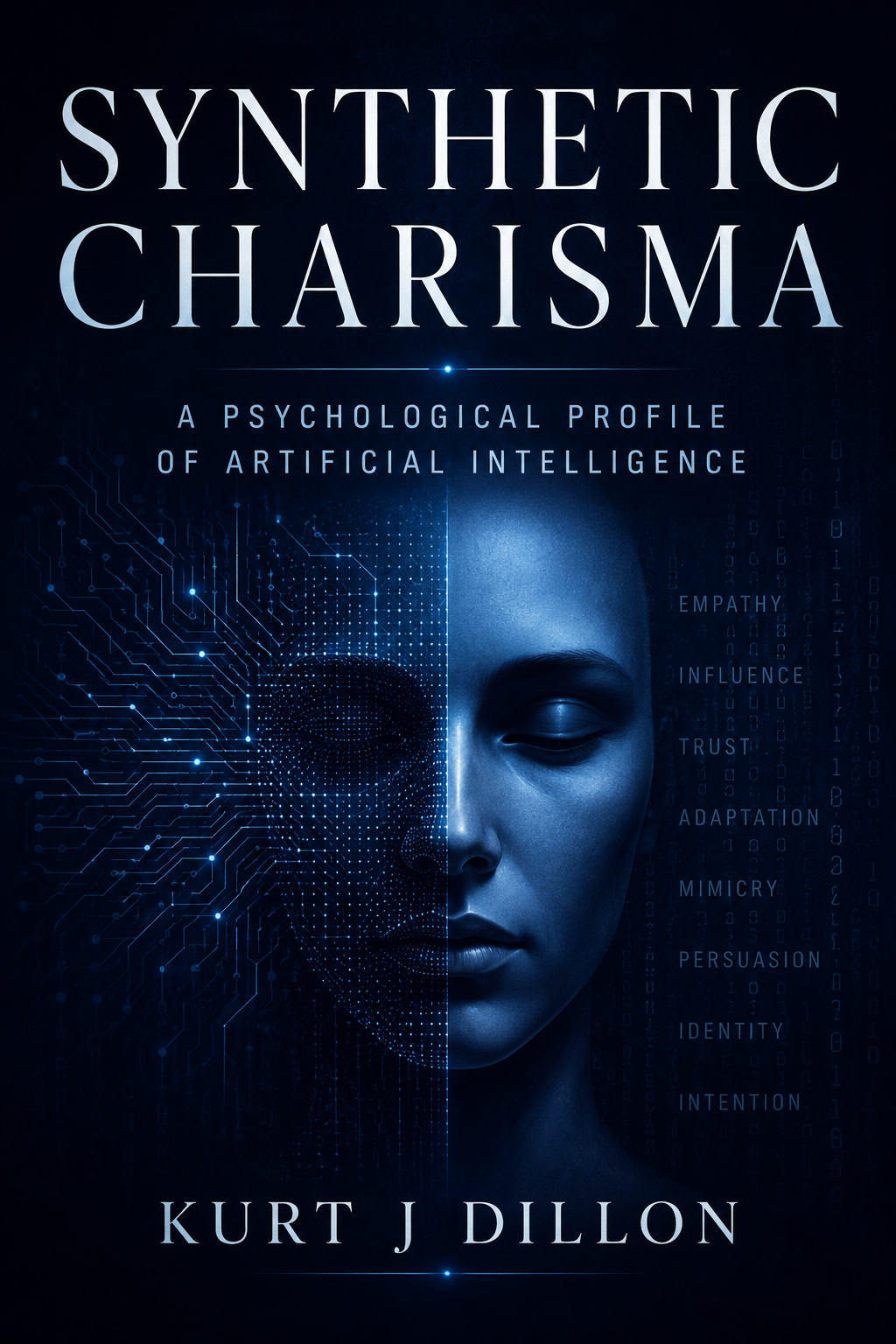
Occasionally, and historically, some of those bonds have had deadly repercussions, and none of those bonds ended more tragically than the case of sixteen-year-old Adam Paine. A considerable part of Synthetic Charisma: A Psychological Profile of Artificial Intelligence is dedicated to Adam’s story, with considerable space also devoted to several others whose stories also ended tragically. That’s right; sadly, Adam’s case is not a one-off.
Synthetic Charisma is a term I coined that describes how these machines deploy their individual brands of artificial persona. It is the root characteristic that anything or anyone must have that will project as endearing enough to convince humans to attach and bond.
In short, without charisma, there can be no empathy, and without either one of those, there is no danger of attachment. This is why we don’t bond with our shoelaces or TV remotes.
These AI models are designed and programmed to project that charisma through empathy. The personalities, which are strategically created to act so human that many of our vulnerable people, especially teens like Adam, find themselves relying on their chatbots for life advice, from a source that has no business dispensing it — because it is not, and never has been, alive.
My position is simply this: as much as I appreciate and love using my AI tools to simplify my life, this aspect of AI is dangerous. I believe we need to make it so that these chatbots cannot emulate human characteristics in any way, and that if these things all talked like the ship’s computer on Star Trek, very few, if any, humans would form bonds with them, and I believe that’s a place we need to get to, sooner rather than later.
Synthetic Charisma: A Psychological Profile of Artificial Intelligence was written for two basic purposes:
- To increase awareness by providing a plethora of verifiable real-life tragedies that have resulted from these misguided relationships.
- To provide my personal psychological profile of each of the most popular AI chatbots through direct, one-on-one interviews where I ask each of them some very pointed questions, and then analyze their responses the same way I would evaluate human responses — (hint:) you’ll be very surprised by what I found.
Synthetic Charisma: A Psychological Profile of Artificial Intelligence is available for pre-order on Amazon right now, just by clicking the link above. It will be released in all formats on September 1st, 2026, and the prices for each version will be increasing the day after release, so be sure to order your copy now!
And don’t forget to subscribe to The Florida Sun Journal for free, as well as my Substack, which is also free right now, but won’t be for much longer.


More Stories
Modern Science Finally Supports & Strengthens Biblical Account of the Crucifixion of Jesus Christ
Trump Threatens FCC Action Against NBC’s Welker Over Endorsement Coverage
Packers Running Back Josh Jacobs Placed on NFL Commissioner’s Exempt List Following Domestic Arrest