


💛 A quick favor, if you've got a second.
We're really happy that you chose to read one of our stories and sincerely hope you'll stick around to read more. We took our paywall down — for now — but that won't last forever, and when the gate goes back up, we'd love for you to already be on the inside.
It's free. So please enter your email here and don't forget to like and follow us on all of your favorite Social Media platforms!
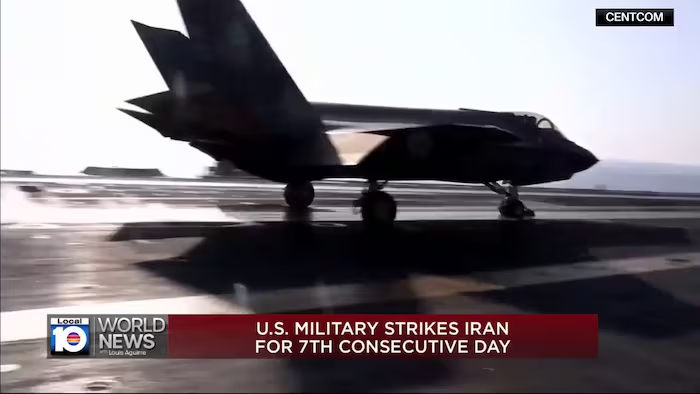
Military confrontations between Washington and Tehran reached a critical point Friday as both nations expanded their offensive operations throughout the Middle East. The escalation marks more than four months of continuous hostilities without diplomatic progress following the collapse of a previous ceasefire accord.
American forces broadened their strike campaign to include Iranian transportation infrastructure, electrical power facilities, and maritime installations. U.S. military officials pointed to damage inflicted on a surveillance facility at Chabahar port on the Gulf of Oman, which they attributed to Iran’s Revolutionary Guard Corps.
Iran responded with sustained missile and drone attacks targeting regional partners and nations hosting U.S. military bases. Qatar activated air defense systems that intercepted multiple incoming projectiles over two separate incidents, though falling debris wounded a civilian child in the aftermath.
A critical desalination plant in Kuwait sustained damage from Iranian missile fire, threatening the country’s water security as the facility typically provides approximately 90 percent of the nation’s fresh water supply. Officials have expressed concern about the long-term impact on civilian access to potable water.
President Donald Trump characterized the American military campaign as producing positive outcomes during remarks Thursday evening. The president asserted that momentum favored U.S. interests and indicated that tangible results would materialize imminently.
U.S. Central Command confirmed that seven consecutive nights of bombing operations targeted Iranian military capabilities. The Pentagon disclosed that 13 American personnel sustained injuries beginning Monday, comprising 10 Army soldiers and three naval sailors.
Iranian authorities reported that American strikes killed at least 46 people and injured more than 400 others. A single attack on a bridge in southern Iran on Friday resulted in eight deaths, according to government statements.
Recent nighttime operations concentrated on bridge structures linking Iran’s major port facility at Bandar Abbas with central and northern zones including Tehran. Military strategists chose these targets to sever logistical pathways supporting Iran’s inland regions.
Iran’s Energy Ministry confirmed power grid damage for the first time Friday, instructing residents in southern territories enduring extreme heat to curtail electricity consumption. The ministry declined to specify which installations suffered damage or the extent of harm.
Control of the Strait of Hormuz has emerged as the central objective driving the military campaign. Iran has demanded exclusive authority over the waterway and seeks to levy fees on international commercial vessels, departing from the established international consensus that treats it as an open shipping corridor.
The strait typically accommodates approximately one-fifth of worldwide petroleum and liquefied natural gas commerce. Thursday’s transit count fell to just eight vessels, marking the lowest three-week traffic figure.
Oil markets responded to the shipping disruptions with crude climbing above $86 per barrel Friday. The Trump administration has simultaneously imposed additional enforcement mechanisms targeting Iranian petroleum sales through maritime operations.
Beyond Qatar, Iranian forces deployed missiles and unmanned aircraft striking locations in Bahrain and Kuwait during early Friday morning hours. Kuwaiti military officials reported drone strikes on defense facilities, citing unspecified casualty figures and destruction affecting water and power systems.
Jordan’s military successfully intercepted three Iranian missiles before impact Friday morning. Northern Iraq’s Kurdish-administered territories also came under fire as air defense networks responded to incoming projectiles near Irbil.
Komala, an Iranian opposition faction, appeared to be the intended target of strikes in Kurdish Iraq based on preliminary casualty reports numbering at least nine dead. While Iran has previously conducted military operations against the organization, no official statement accompanied Friday’s attacks.
A commercial vessel transiting the strait experienced an attack Friday according to British defense monitoring sources. The ship sustained minor damage without crew injuries, though responsibility for the assault remained unconfirmed.

More Stories
Colombia backs Trump security push while limiting U.S. role in anti-gang operations
Chicago Mayor Issues Executive Order Requiring Contractor Diversity Disclosures and ICE Ties Reporting
Federal Prosecutors Convene Special Grand Jury to Investigate D.C. Schools’ Attendance and Graduation Practices