


💛 A quick favor, if you've got a second.
We're really happy that you chose to read one of our stories and sincerely hope you'll stick around to read more. We took our paywall down — for now — but that won't last forever, and when the gate goes back up, we'd love for you to already be on the inside.
It's free. So please enter your email here and don't forget to like and follow us on all of your favorite Social Media platforms!
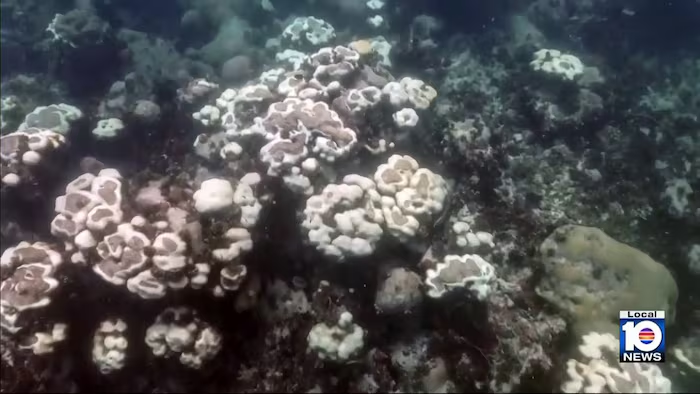
Alarm bells are ringing at the National Oceanic and Atmospheric Administration as South Florida’s coral reefs face yet another threat from rising ocean temperatures. Scientists monitoring the region have already documented bleaching at Cheeca Rocks, a historically resilient reef site that serves as a critical climate indicator, with conditions deteriorating faster than officials anticipated for early July.
Ian Enochs, who directs the coral program at NOAA’s Miami laboratory, expressed grave concern over the trajectory. The Midwestern Regional Climate Center reports that South Florida has endured 38 consecutive days of triple-digit heat indices, pushing ocean temperatures into dangerous territory and prompting NOAA to elevate its bleaching alert for portions of the Florida Reef Tract.
The current crisis echoes the devastation of July 2023, when the planet’s hottest month on record triggered the most severe mass bleaching event in Florida’s history. Enochs noted that stress levels on corals at Cheeca Rocks are already exceeding those observed during that catastrophic summer, raising fears of an equally destructive or worse outcome in the weeks ahead.
Over four decades, Florida’s Reef Tract has shed more than 90 percent of its healthy coral coverage due to disease, pollution, and repeated bleaching cycles driven by climate change. Despite these setbacks, some reefs remain among the healthiest remaining, making their current deterioration particularly troubling for ecosystem recovery prospects.
The Coral Restoration Foundation, the world’s largest coral restoration organization, is mobilizing preventative measures to protect vulnerable species. Program manager Phanor Montoya revealed that the organization has requested regulatory approval to relocate approximately 3,500 corals from various nurseries to Elbow nurseries, where conditions are more favorable, should summer conditions worsen.
During the 2023 marine heat wave, CRF’s emergency response involved relocating thousands of corals from offshore nurseries to land-based facilities, yet losses were staggering. The organization began summer with 45,000 corals across all nurseries but lost 52 percent of its stock by October, leaving only 17,000 survivors.
The University of Miami’s Rosenstiel School has launched a reconnaissance and recovery operation targeting threatened elkhorn coral colonies. The initiative aims to collect genetically diverse specimens for land-based preservation, ensuring species survival should the bleaching event intensify beyond current projections.

More Stories
Forest Service Proposes Steep Fee Increases at Lake Tahoe Recreation Sites
Son Discovers Father Missing After Himalayan Disaster in Nepal-Tibet Border Region
Month-Long HEPA Use Linked to Faster Cognitive Processing in Middle-Aged Adults