


💛 A quick favor, if you've got a second.
We're really happy that you chose to read one of our stories and sincerely hope you'll stick around to read more. We took our paywall down — for now — but that won't last forever, and when the gate goes back up, we'd love for you to already be on the inside.
It's free. So please enter your email here and don't forget to like and follow us on all of your favorite Social Media platforms!
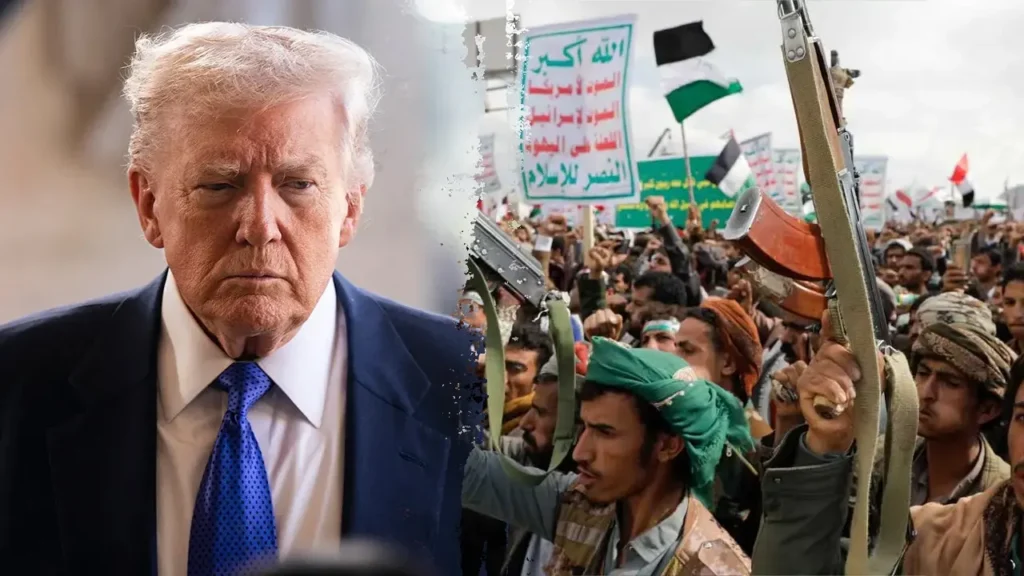
President Donald Trump on Tuesday issued a warning to Yemen’s Iranian-backed Houthis, stating the United States would intervene should the group proceed with announced plans to blockade Saudi Arabia’s shipping lanes. The administration is backing renewed Saudi military operations against the organization, according to reports from multiple outlets.
The Houthis declared their intention to establish a naval blockade against Saudi Arabia on Monday, following airstrikes by Saudi forces on Sanaa International Airport. Intelligence reports indicate Iran has instructed the militant group to prepare for closure of the Bab el-Mandeb Strait should the U.S. attack Iranian power infrastructure.
“So far, it hasn’t happened, might happen, but we take care of things,” Trump said from the Oval Office. “If something like that happens, we take care of it.”
Saudi forces targeted Sanaa International Airport after an Iranian Mahan Air aircraft carrying Houthi officials diverted from its flight path. A U.S. official indicated the plane likely transported weapons, missile components and Iranian military advisers destined for the Houthis.
The escalation underscores growing concern that simultaneous disruptions at two critical maritime chokepoints could severely impact global commerce. Together, the Strait of Hormuz and Bab el-Mandeb facilitate roughly one-third of worldwide seaborne oil trade, serving as essential routes for energy moving between Asia, Europe and the Middle East.
Since late 2023, the Houthis have executed more than 190 attacks against commercial vessels transiting the Red Sea, prompting major shipping companies to abandon the route for longer passages around Africa. The group has evolved into one of Iran’s most strategically important regional partners, allowing Tehran to pressure international commerce without direct military confrontation.
Saudi Crown Prince Mohammed bin Salman secured Trump’s approval before launching the current strikes, according to reporting from Axios. This week’s military exchanges mark the most significant cross-border escalation between the nations in approximately four years.
Bridget Toomey, research analyst at the Foundation for Defense of Democracies, characterized Saudi Arabia’s response as a “measured escalation” intended to prevent Iran from establishing a direct air corridor into Houthi-controlled Yemen. Such flights would facilitate weapons transfers and deployment of Iranian Revolutionary Guard Corps personnel, she noted.
Experts warn that a direct supply line between Tehran and Sanaa would threaten not only Saudi Arabia but broader international security interests. The Bab el-Mandeb Strait, which connects the Red Sea to the Gulf of Aden, annually handles nearly 15 percent of global seaborne trade, making it one of the world’s most vital maritime passages.
Gregg Roman, executive director of the Middle East Forum, stated Trump’s support for Saudi operations reflects an administration committed to backing regional allies while countering Iranian-backed groups that disrupt maritime commerce. Continued military pressure on the Houthis could significantly increase the costs of Iran’s broader Middle East strategy.

More Stories
Federal voting arrest in New Jersey adds new pressure point in Sherrill-Trump standoff
Colombia backs Trump security push while limiting U.S. role in anti-gang operations
Former NFL cheerleader and ex-aide face off in close Rhode Island GOP primary