


💛 A quick favor, if you've got a second.
We're really happy that you chose to read one of our stories and sincerely hope you'll stick around to read more. We took our paywall down — for now — but that won't last forever, and when the gate goes back up, we'd love for you to already be on the inside.
It's free. So please enter your email here and don't forget to like and follow us on all of your favorite Social Media platforms!
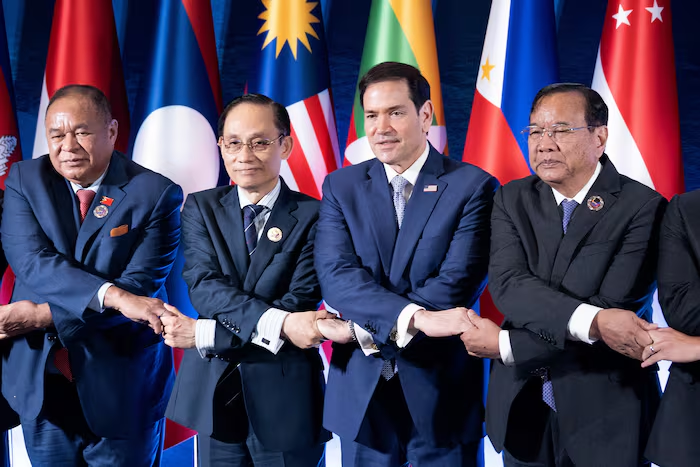
Secretary of State Marco Rubio addressed Southeast Asian foreign ministers Wednesday in Manila, warning that Tehran’s push to regulate and levy fees on the Strait of Hormuz would destabilize the global economy and undermine a core international principle. Speaking at the start of the annual Association of Southeast Asian Nations gathering, Rubio stressed U.S. commitment to the region despite Washington’s focus on Middle East tensions. “We’re with ASEAN 100%,” he said.
Rubio articulated concerns that allowing any nation to monopolize an international shipping channel, impose tolls, and attack non-compliant vessels would create a model other countries might replicate worldwide. “If we create a precedent in the Middle East where a nation state can decide that they are going to control an international waterway, charge a toll and if you don’t pay them, blow up your ships, we have created a very dangerous precedent which will repeat itself in other parts of the world, including in this region,” he explained.
The Secretary of State convened separately with counterparts from the four-member Quad partnership—comprising the United States, Australia, India, and Japan—to discuss technology cooperation, disaster response, and maritime security initiatives designed to limit Beijing’s expanding regional influence. The group released a joint statement reaffirming their dedication to maintaining peace and stability in the Indo-Pacific maritime domain.
Rubio held bilateral talks with Indian External Affairs Minister Subrahmanyam Jaishankar, focusing on regional matters and the Middle East conflict alongside progress toward a trade agreement aimed at reducing Trump administration tariffs on Indian products. State Department spokesperson Tommy Pigott noted the two officials underscored the importance of completing the nearly finalized interim trade deal.
The three-day Manila meetings, which commenced Tuesday, prioritize territorial disputes in the South China Sea involving China, Taiwan, Philippines, Vietnam, Malaysia, and Brunei. Rubio was slated to meet separately with Chinese Foreign Minister Wang Yi at the convention complex near Manila Bay.

More Stories
Federal voting arrest in New Jersey adds new pressure point in Sherrill-Trump standoff
Colombia backs Trump security push while limiting U.S. role in anti-gang operations
Former NFL cheerleader and ex-aide face off in close Rhode Island GOP primary