



💛 A quick favor, if you've got a second.
We're really happy that you chose to read one of our stories and sincerely hope you'll stick around to read more. We took our paywall down — for now — but that won't last forever, and when the gate goes back up, we'd love for you to already be on the inside.
It's free. So please enter your email here and don't forget to like and follow us on all of your favorite Social Media platforms!
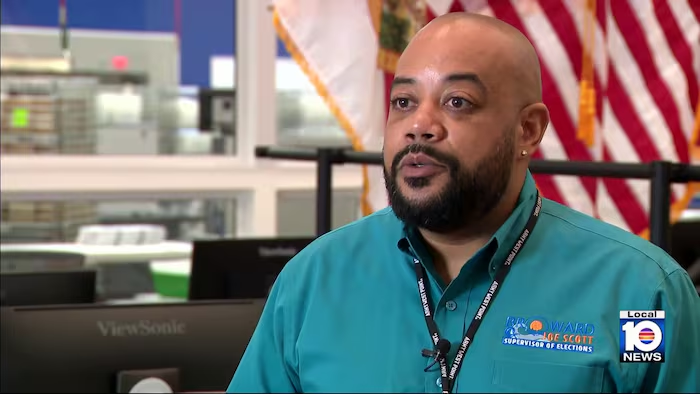
Joe Scott, the Broward County Supervisor of Elections, said the Systematic Alien Verification for Entitlements, or SAVE, database to track migrants who are not U.S. citizens, isn’t updated as regularly as it needs to be. Scott was reacting to the Supreme Court’s decision on Friday to lift restrictions on the SAVE, a Department of Homeland Security database to verify voters’ eligibility for the midterm election on Nov. 3. “If everybody in the government complies with the law and is cautious about how this tool is used, there should be no problem,” Scott said, adding that its use is voluntary. The court’s emergency order grants President Donald Trump a temporary victory. Justices Ketanji Brown, Elena Kagan, and Sonia Sotomayor dissented. Scott said he is concerned that SAVE may wrongly exclude eligible voters. “There will be people who are in fact U.S. citizens who are also in this database, and that’s what makes it such an imperfect tool,” Scott said. Justice Ketanji Brown Jackson dissented, joined by Justices Elena Kagan and Sonia Sotomayor. The database has long been seen to fall under federal privacy laws, she wrote, and there are real risks that legitimate voter registrations could be mistakenly revoked.“The harm caused by burdening or disenfranchising even a few lawful voters outweighs the nonexistent harm that the Government experiences when it is prevented from taking an action that it likely lacks the authority to take,” Jackson wrote.The plaintiffs pledged to do “everything in our power” to ensure the district court decision stands.Trump administration tool has wrongly flagged some legal registrantsThe SAVE program was created under an immigration law mandating that DHS help federal, state and local agencies prevent government benefits from going to noncitizens. The Trump administration last year moved to significantly expand its search abilities. Since then, at least 67 million registrations have been scanned through the program, but critics worry it could end up purging valid voters from the rolls.Some registrants have already been wrongly flagged. In Travis County, Texas, for example, officials said they investigated 97 voters flagged by SAVE as apparent noncitizens and found that at least 10% of them — and likely up to 21% — were U.S. citizens. The county urged the Supreme Court to reject the administration’s appeal, while the state of Texas submitted its own brief defending the database.In Denton, Texas, north of Dallas, voter Anthony Nels was disappointed that the Supreme Court allowed the continued use “of a system that harms people’s constitutional right to vote.”Last year, after Texas ran its voter registrations through the SAVE system, Nels, 29, was flagged as a potential noncitizen, even though the South Africa native had become a U.S. citizen more than a decade ago. His local election office temporarily canceled his registration while he obtained a new passport to replace an expired one.“This just seems like another illegitimate way to affect upcoming and future elections,” he said in a text to The Associated Press.Stephen Richer, the Republican former top election official in Arizona’s largest county, said the Supreme Court’s ruling could be a positive step “if used responsibly.”“That being said, the SAVE program has been shown time after time to be a highly-imperfect tool, so election administrators should only use it as a starting point, not as a definitive indicator of citizenship,” he wrote on social media.SAVE is one piece of the administration’s crusade against noncitizen votingEven though the use of the SAVE program was blocked for months ahead of Friday’s ruling, the administration has said in court filings that it has continued using Social Security Administration data “in certain cases to verify information and help determine whether illegal voting may have occurred.”DHS in August launched its own investigation to find noncitizen voters on state rolls, according to a federal whistleblower statement that said the effort is rushed, filled with errors and potentially violates state laws. DHS has defended that investigation as being conducted “diligently and professionally.”Homeland Security Secretary Markwayne Mullin also suggested over the summer that there could be as many as 250,000 noncitizens registered to vote across four states, an unsubstantiated claim that puzzled state election officials who said the numbers dramatically exceeded their own findings.The effort to create a national voter list is among numerous steps Trump has taken during his second term to try to overhaul the way elections are run. Most of those steps have been blocked by various courts, in part because the Constitution gives states and Congress the authority to set election rules, but provides no such power to the president. In mid-September, the Supreme Court rejected a bid from Trump to restrict mail ballot procedures before the midterms.Trump has remained fixated on the idea that massive numbers of noncitizens are voting in U.S. races, but all evidence says otherwise.Ahead of the 2024 presidential election, Georgia’s secretary of state found that 20 of the state’s 8.2 million registered voters were not U.S. citizens. In Ohio, prosecutors secured indictments against nine people for voting as noncitizens over the span of 10 years. The state has some 8 million registered voters. Even with the Trump administration laser-focused on the issue in his second term, DHS said its investigations into potential noncitizens on voter rolls nationwide had led to 160 arrests.Those numbers are supported by a mountain of research at the national and state level that has found the percentage of noncitizens on voter rolls is a tiny fraction of the nation’s nearly 228 million registered voters.___Hanna reported from Topeka, Kansas, and Whitehurst reported from Washington.


More Stories
Driver crashes into parked cars, home during medical emergency in Sunrise
Phillies shut out by Rays in opener of final regular-season series, pushing playoff hopes to the brink
High School Spotlight: Cypress Bay beats Western in overtime rivalry game