

💛 A quick favor, if you've got a second.
We're really happy that you chose to read one of our stories and sincerely hope you'll stick around to read more. We took our paywall down — for now — but that won't last forever, and when the gate goes back up, we'd love for you to already be on the inside.
It's free. So please enter your email here and don't forget to like and follow us on all of your favorite Social Media platforms!
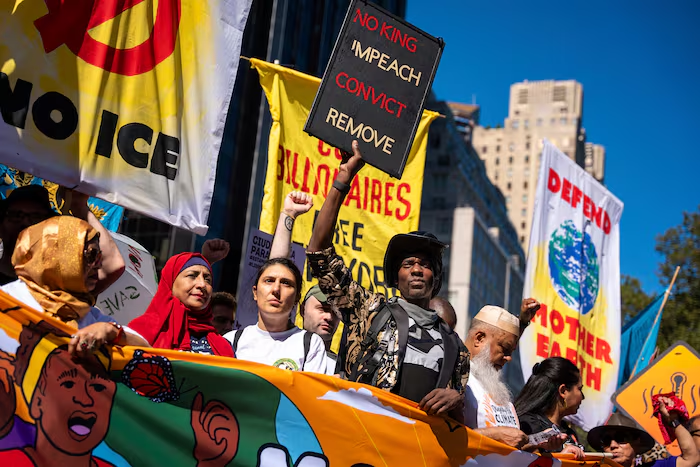
Climate change has receded from the forefront of Democratic campaign messaging this election cycle, marking a dramatic departure from the party’s emphasis on environmental issues during the 2020 race. Researchers have begun using the term “climate hushing” to describe how the issue has been sidelined, even as scientists warn that 2024 could rank among the hottest years on record. The shift represents a fundamental realignment of Democratic campaign priorities.
The Massachusetts Democratic primary for U.S. Senate, featuring incumbent Ed Markey, 80, and challenger U.S. Rep. Seth Moulton, 47, exemplifies this transformation. While Markey authored the Green New Deal proposal, his campaign now emphasizes other issues to demonstrate his fitness for office and his willingness to confront former President Donald Trump. Democratic strategists say the overriding campaign theme has become opposition to Trump rather than climate action.
The Democratic think tank Searchlight Institute explicitly recommended last year that the party avoid emphasizing climate change, arguing that voters view the issue as too complex and intimidating. Instead, party strategists have suggested that Democrats could more effectively gain power by focusing on other concerns and then tackling climate issues once in office. This calculation has reshaped how candidates discuss environmental policy.
Affordability concerns, support for Israel, and resistance to Republican policies have dominated Democratic discourse instead. About six in ten Democrats consider climate change “a very big problem,” according to an April Pew Research Center poll, but voter priorities consistently rank inflation, healthcare costs, and money in politics higher. The shift reflects a strategic decision that economic messaging resonates more powerfully with voters.
The Sunrise Movement, founded in 2017 to mobilize young voters on climate issues, announced in October that it was pivoting toward a broader fight against authoritarianism. Executive Director Aru Shiney-Ajay stated that voters have become preoccupied with existential concerns related to democracy and government overreach, overshadowing long-term environmental priorities. The group’s reorientation signals how dramatically campaign landscapes have shifted in just six years.
Some climate advocates are reframing the issue around economic benefits rather than environmental catastrophe. Democratic strategists now highlight how green energy can reduce electricity costs and lower insurance premiums, attempting to align climate action with voter concerns about household expenses. This approach represents an adaptation to the current political climate rather than abandonment of the underlying issue.
Political scientists and climate experts have expressed alarm at the de-emphasis of environmental messaging. Leah Stokes, author of “The Carbon Wave,” called the strategy “galling,” warning that a decade of reduced climate focus would accelerate planetary damage. Anthony Leiserowitz, director of Yale’s climate communication program, stressed that decisions made over the next decade will determine planetary habitability for millennia.
U.S. Sen. Sheldon Whitehouse of Rhode Island has characterized the pivot as a strategic “blunder,” noting that climate change increasingly affects pocketbook issues through home insurance costs and property values. He argued that framing climate as an economic problem, rather than purely environmental, could revive its political salience. Still, such voices remain marginal in current Democratic campaign strategy.

More Stories
Colombia backs Trump security push while limiting U.S. role in anti-gang operations
Former NFL cheerleader and ex-aide face off in close Rhode Island GOP primary
Chicago Mayor Issues Executive Order Requiring Contractor Diversity Disclosures and ICE Ties Reporting