


💛 A quick favor, if you've got a second.
We're really happy that you chose to read one of our stories and sincerely hope you'll stick around to read more. We took our paywall down — for now — but that won't last forever, and when the gate goes back up, we'd love for you to already be on the inside.
It's free. So please enter your email here and don't forget to like and follow us on all of your favorite Social Media platforms!
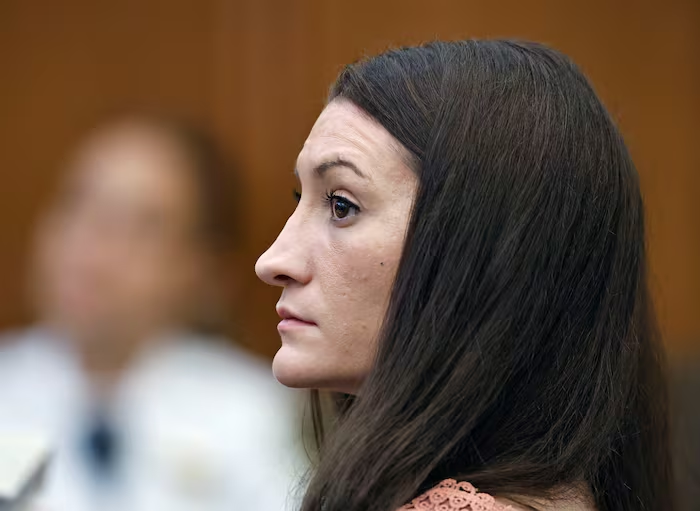
Jurors began their deliberations this week in the closely watched case against Lindsay Clancy but had not yet reached a verdict by Friday evening. The jury must decide whether the former labor and delivery nurse should face criminal accountability for the deaths of her three young children at her Massachusetts home in 2023. Prosecutors and defense attorneys agree on the basic facts of what occurred but fundamentally disagree on Clancy’s state of mind at the time.
The defense maintains that Clancy suffered from postpartum psychosis and received inadequate mental healthcare, conditions that precipitated the tragedy. Prosecutors contend that Clancy deliberately planned and executed the killings. A conviction could result in a life sentence, while an acquittal might lead to her release or continued confinement in a mental health facility.
Patrick Clancy, the children’s father, provided emotionally wrenching testimony detailing the moment he discovered his wife had attempted suicide and their children were dead. He recalled the unusual silence in the home, bloodstains in the bedroom, and an open window. The jury heard the 911 call he made, in which he can be heard anguishing over his wife before discovering the children in the basement.
Multiple family members and colleagues testified that Clancy exhibited clear signs of mental distress following the birth of her youngest child. Her mother-in-law, Susan Clancy, described Lindsay as having become anxious, paranoid and suicidal despite receiving psychiatric treatment. Lindsay’s mother, Paula Musgrove, shared text messages in which her daughter expressed severe insomnia, fear of being alone and desperate pleas for help.
Defense attorney Kevin Reddington challenged the adequacy of Clancy’s psychiatric care, questioning whether her doctor provided sufficient attention during brief video appointments. He suggested that Dr. Jennifer Tufts, one of Clancy’s treating psychiatrists, functioned more as a box-checking administrator than a thoughtful clinician engaged in meaningful treatment.
A clinical psychologist testified that Clancy reported hearing a disembodied male voice commanding her to kill her children and then herself, supporting the defense’s argument that severe mental illness drove her actions. However, prosecutors presented a rebuttal witness who rejected this account, noting that Clancy’s statements about the killings—including saying “Go to God, baby” to each child—suggested conscious intent rather than hallucination-driven behavior.
During closing arguments, Reddington displayed contrasting photographs of the Clancy family at a happier time and Lindsay in the hospital, asking jurors how such a transformation could occur without systemic medical failures. Prosecutor Jennifer Sprague countered that mental health system shortcomings were irrelevant distractions, arguing instead that Clancy killed her children to remove what she viewed as obstacles to her own death.

More Stories
Federal voting arrest in New Jersey adds new pressure point in Sherrill-Trump standoff
Packers Running Back Josh Jacobs Placed on NFL Commissioner’s Exempt List Following Domestic Arrest
Federal Prosecutors Convene Special Grand Jury to Investigate D.C. Schools’ Attendance and Graduation Practices