


💛 A quick favor, if you've got a second.
We're really happy that you chose to read one of our stories and sincerely hope you'll stick around to read more. We took our paywall down — for now — but that won't last forever, and when the gate goes back up, we'd love for you to already be on the inside.
It's free. So please enter your email here and don't forget to like and follow us on all of your favorite Social Media platforms!
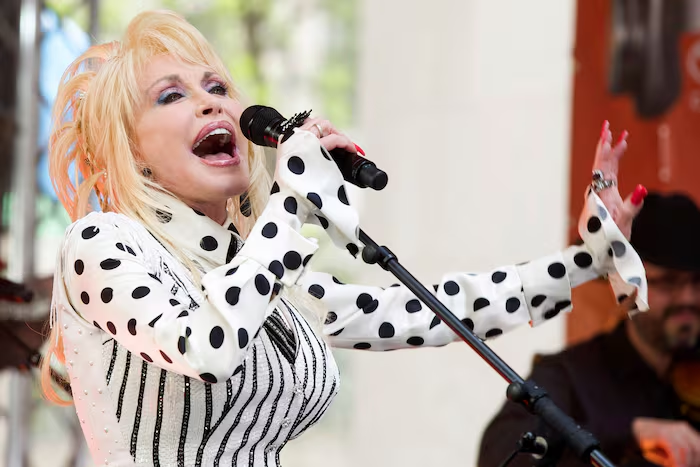
Dolly Parton graced the January 1987 cover of Ms. magazine as one of 12 Women of the Year, alongside a U.S. senator, acclaimed novelist, and human rights activist. The country music legend, who passed away this week at age 80, appeared alongside feminism pioneer Gloria Steinem in recognition of her cultural impact. Yet Parton consistently resisted being called a feminist, deflecting the label much as she sidestepped political categorization throughout her career.
What mattered most to those who admired her were not the words Parton used to describe herself, but rather how she lived her life. Her business acumen, songwriting choices, personal relationships, and lyrical content revealed an uncompromisingly independent spirit beneath the wigs and rhinestones. Fans and critics alike recognized in Parton’s work a powerful feminist voice, whether she claimed the title or not.
Lynn Melnick, author of “I’ve Had to Think Up a Way to Survive: On Trauma, Persistence, and Dolly Parton,” spent years examining how the singer’s music addressed feminist themes. Melnick observed that Parton communicated her values through actions and artistry rather than declarations. The singer’s approach resonated deeply because it felt authentic and accessible rather than preachy.
At the 2019 Newport Folk Festival, crowds erupted in cheers when Parton performed “Just Because I’m a Woman,” a song confronting the sexual double standard. Parton explained to the audience how the song emerged from a conversation with her husband about expectations placed on women versus men in marriage. Her blend of humor and relatability made serious points without creating division.
Steinem herself articulated Parton’s feminist contributions in that 1987 Ms. magazine issue. The legendary activist noted that Parton leveraged her business sense to elevate other women and economically disadvantaged communities. Steinem wrote that if feminism means discovering one’s unique power and helping others do the same, Parton had undoubtedly achieved both.
Music scholar Evelyn McDonnell argues that Parton’s glamorous appearance actually functioned as protective camouflage for her progressive message. By embracing the visual symbols of female objectification, Parton could express feminist ideas while disarming potential critics through her nonthreatening presentation. Songs like “9 to 5,” performed alongside Lily Tomlin and Jane Fonda, directly addressed workplace equality and women’s economic power.
Throughout her discography, Parton tackled reproductive justice, teen pregnancy, equal pay, and sexual double standards. “The Bargain Store,” released in 1975, used metaphor to celebrate a woman’s worth independent of male validation, though country radio largely rejected it. “Down from Dover” gave voice to unwed mothers at a time when radio stations refused to acknowledge such topics.
Author Melnick identifies Parton as an early practitioner of third-wave feminism, which emerged in the 1990s emphasizing individual choice. Within this framework, a woman could wear big hair, high heels, and sequins as deliberate personal decisions rather than forced conformity. Parton articulated this philosophy during a 1977 Barbara Walters interview, describing her appearance as a conscious choice.
When Walters pressed Parton on her image, marriage, and physical appearance with pointed skepticism, the then-31-year-old responded with composure and self-assurance. Parton explained that her confidence in her talent and self-worth allowed her to play with aesthetics without feeling diminished by them. She articulated a definition of feminism rooted in self-respect and respect for others—principles Steinem herself had championed.

More Stories
Looney Tunes’ ‘Coyote vs. Acme’ Debuts With $15.5 Million as ‘Spider-Man’ Holds Box Office Crown
Country Music Legend Dolly Parton Laid to Rest; Niece Shares Touching Remembrance
Britt Baker’s Surprise Return Helps Persephone Capture AEW TBS Championship at All In