


💛 A quick favor, if you've got a second.
We're really happy that you chose to read one of our stories and sincerely hope you'll stick around to read more. We took our paywall down — for now — but that won't last forever, and when the gate goes back up, we'd love for you to already be on the inside.
It's free. So please enter your email here and don't forget to like and follow us on all of your favorite Social Media platforms!
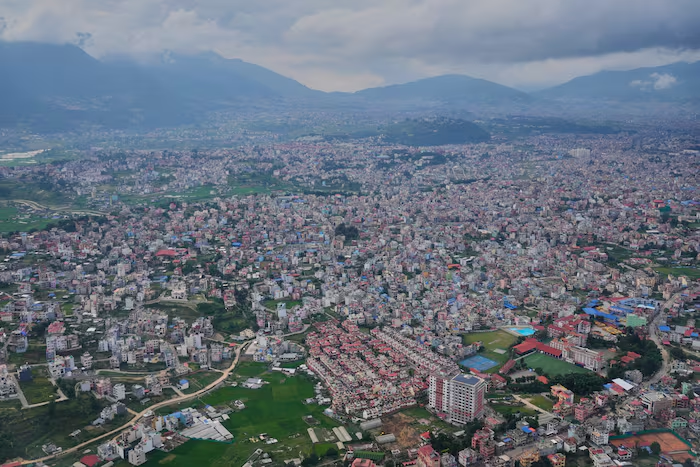
A catastrophic glacier collapse in the Himalayan mountains straddling Nepal and China unleashed flash floods this week that have claimed hundreds of lives and caused widespread devastation across the border region. The disaster underscores the inherent perils of one of Earth’s most challenging geographic environments, where powerful natural forces can strike with little warning. Despite these dangers, the mountain range continues to attract visitors from around the globe who undertake dangerous journeys to experience some of the planet’s most spectacular terrain.
The missing now include people from at least 30 countries alongside local residents whose families have inhabited these mountains for generations. The flood’s toll reflects the region’s dual nature as both a remote ancestral homeland and an increasingly popular international destination. Search and rescue operations continue while forecasters warn of additional flooding threats in the coming days.
Mountain traversal through this region dates back centuries, with traders historically moving goods along portions of the Great Silk Road. The Sherpa ethnic groups of Nepal developed unparalleled mountaineering expertise that would later prove invaluable to foreign expeditions. In 1953, Sherpa Tenzing Norgay and New Zealand mountaineer Edmund Hillary made history as the first humans to summit Mount Everest, the world’s tallest peak, marking a turning point for international mountaineering interest.
Tourism has since become increasingly central to Nepal’s economy, with trekking routes drawing adventurers to iconic destinations like Everest Base Camp and the Annapurna conservation area. In May alone, a record 274 climbers reached Everest’s summit in a single day, highlighting the surge in popularity. This growth has spurred infrastructure development including improved roads, lodging facilities, and restaurants across previously remote areas.
Rajendra Lama, general secretary of the Nepal Mountaineering Association and a guide for over 20 years, noted that visitors now expect modern conveniences previously unimaginable in these mountains. “There’s a big difference from when I started,” he told The Associated Press. “Nowadays people need more facilities,” including amenities such as pizza establishments in regions once entirely isolated.
Many international visitors emphasize that Nepal’s primary appeal remains its untamed natural beauty and authentic cultural heritage despite encroaching modernization. Photographer Ariel Estulin from Toronto has visited Nepal four times over 15 years, traveling to remote areas requiring grueling multi-day bus journeys where accommodation meant requesting shelter from local farmers. “It is changing,” Estulin said, “but it will always remain wild.”
Lama expressed confidence that the international community’s deep affection for Nepal will sustain the country through this crisis, drawing parallels to the nation’s recovery following the devastating 2015 earthquake. He credited the flood’s survivors and affected communities with the same resilience that brought tourists back after that tragedy. Support messages have already begun pouring in from around the world, he said, underscoring a sentiment he summarized simply: “People love Nepal.”

More Stories
Colombia backs Trump security push while limiting U.S. role in anti-gang operations
Federal Prosecutors Convene Special Grand Jury to Investigate D.C. Schools’ Attendance and Graduation Practices
State Department Reissues Level 3 Travel Advisory for Israel Amid Terrorism and Armed Conflict Concerns