


💛 A quick favor, if you've got a second.
We're really happy that you chose to read one of our stories and sincerely hope you'll stick around to read more. We took our paywall down — for now — but that won't last forever, and when the gate goes back up, we'd love for you to already be on the inside.
It's free. So please enter your email here and don't forget to like and follow us on all of your favorite Social Media platforms!
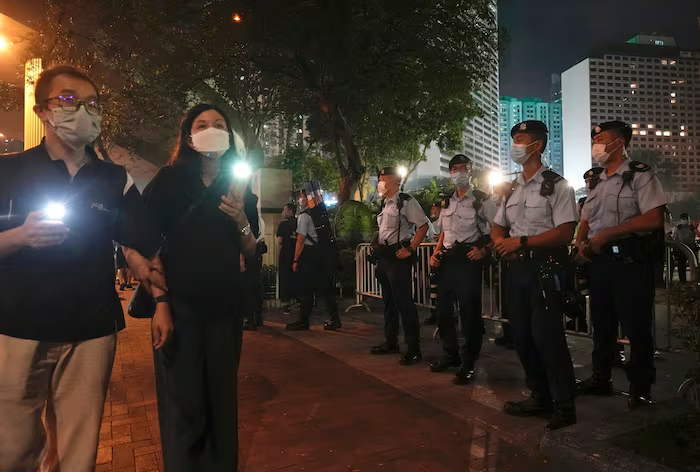
A Hong Kong court heard arguments Friday regarding prison sentences for three former leaders of the Hong Kong Alliance in Support of Patriotic Democratic Movements of China, who were convicted of inciting subversion. Lee Cheuk-yan, Chow Hang-tung and Albert Ho face up to a decade in prison after being charged under a national security law imposed by Beijing in 2021, which has substantially curtailed the territory’s pro-democracy activism.
Lee and Chow entered not guilty pleas and were convicted on August 21, while Ho admitted guilt earlier—a factor that may lead to a reduced sentence. One of the three judges presiding over the case stated sentences would be determined within two weeks. The alliance itself was also found guilty on the same charge of subversion.
The defunct organization became internationally recognized for orchestrating Hong Kong’s sole large-scale public remembrance of the 1989 Tiananmen Square military crackdown, drawing tens of thousands of participants annually for three decades. The court determined that the defendants intentionally encouraged supporters to pursue “end one-party dictatorship” through illegal methods, a core platform of the alliance.
Chow, representing herself in court, rejected the conviction and stated she deserved no prison time whatsoever. She characterized the ruling as criminalizing the pursuit of democracy and declared on social media that she would continue advocating for democratic reform regardless of her imprisonment status.
Defense attorney Erik Shum argued that the defendants’ advocacy work involved no violence and did not destabilize China’s political system or the ruling Communist Party. Foreign governments have expressed concern over the case, citing it as evidence of eroding freedoms promised to Hong Kong upon its 1997 return to Chinese sovereignty.
The vigil organized by the alliance was prohibited in 2020 during the coronavirus pandemic and has not resumed since restrictions lifted, with the traditional memorial site now occupied annually by commercial carnival operations. The court is also expected to rule on whether a university-removed memorial sculpture called the Pillar of Shame, dedicated to Tiananmen victims, can be returned to its owner.
More Stories
Federal voting arrest in New Jersey adds new pressure point in Sherrill-Trump standoff
Colombia backs Trump security push while limiting U.S. role in anti-gang operations
Former NFL cheerleader and ex-aide face off in close Rhode Island GOP primary