


💛 A quick favor, if you've got a second.
We're really happy that you chose to read one of our stories and sincerely hope you'll stick around to read more. We took our paywall down — for now — but that won't last forever, and when the gate goes back up, we'd love for you to already be on the inside.
It's free. So please enter your email here and don't forget to like and follow us on all of your favorite Social Media platforms!
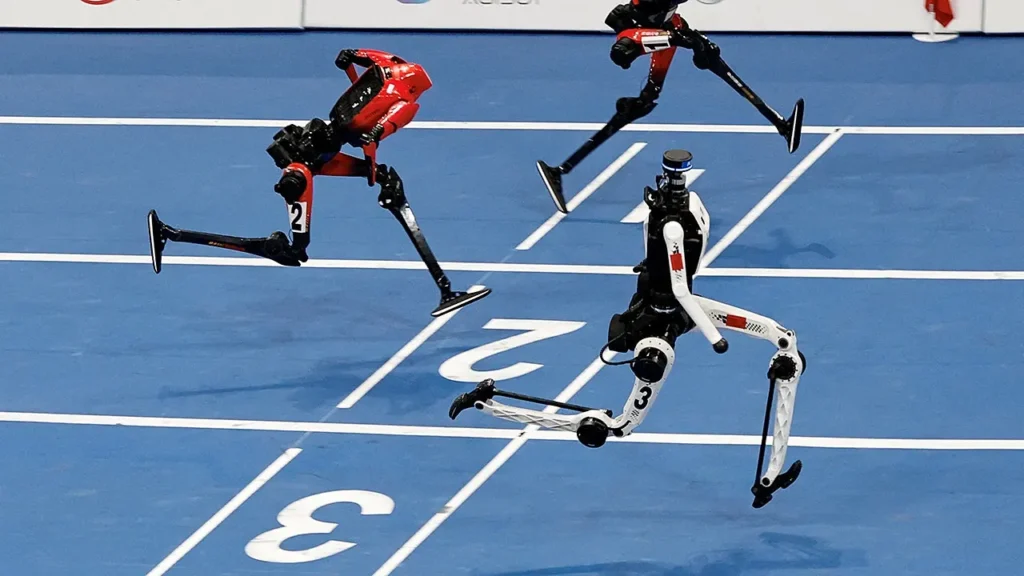
An X-Humanoid robot named TianGong Ultra has completed a 100-meter sprint in 9.32 seconds, eclipsing Usain Bolt’s long-standing human world record of 9.58 seconds set in 2009. The achievement occurred during the second World Humanoid Robot Games in Beijing, which concluded August 26 at the National Speed Skating Oval. While the robot initially posted a time of 9.39 seconds at the event’s opening, the company subsequently announced the improved mark on August 25.
The Games attracted 666 teams operating 2,056 robots across 51 events and 1,301 competition sessions. The competition featured track and field events alongside real-world job simulations, including weightlifting and tug-of-war challenges designed to test both speed and strength. Multiple X-Humanoid teams recorded times below 9.4 seconds, demonstrating significant advances in humanoid robotics capabilities.
The progress becomes more striking when compared to just one year prior. At the inaugural World Humanoid Robot Games in 2025, the winning 100-meter robot finished in 21.50 seconds—a dramatic improvement that underscores rapid technological acceleration. These advances in motor coordination, balance systems and software integration represent substantial engineering breakthroughs in autonomous machine movement.
An X-Humanoid robot also achieved a standing high jump of 2.88 meters, approximately 9 feet 5 inches, exceeding Cuba’s Javier Sotomayor’s 1993 men’s high jump record of 2.45 meters. However, differences in competition mechanics—the robot competed in a standing jump versus Sotomayor’s running approach—mean the official record remains unchanged. The demonstration nevertheless revealed impressive explosive power and body control capabilities.
Robotics engineer Yang Kun of Shanghai-based AG BOT suggested that Chinese companies could develop humanoid robot soldiers within five to 10 years. His company’s A3 humanoid competed in kickboxing at the Games, and Yang discussed potential military applications as one trajectory for humanoid robotics development. The statement reflects where some developers believe the technology is heading, though it represents one engineer’s projection rather than official government policy.
The U.S. Federal Communications Commission has already classified advanced foreign robotic devices as a national security concern. On July 28, the FCC added foreign-produced advanced robotics to its Covered List, restricting imports and sales of qualifying humanoid robots and mobile robotic systems unless they receive conditional approval. The regulatory action signals Washington’s recognition that humanoid robotics represents a strategic technology competition alongside artificial intelligence development.
Despite impressive performances, the robots demonstrate vulnerabilities in real-world conditions. Several fast-running robots crashed into padded barriers after crossing the finish line, indicating gaps between raw speed and reliable control. The Games organizers upgraded the 100-meter event to require fully autonomous competition, while scenario-based challenges involve navigating factory, hotel and home environments to test decision-making beyond simple sprinting.
The technology race between nations hinges on combining advanced artificial intelligence with reliable robot bodies at scale. China has reportedly begun manufacturing preparations to produce thousands of humanoid machines. A country achieving both capable AI systems and mass-produced, physically reliable robots could gain substantial advantages in industrial, disaster response and potentially military applications.
Experts emphasize that navigating unpredictable environments and making autonomous decisions present far greater challenges than running on controlled tracks. A humanoid operating effectively in disaster zones, factories or other hazardous settings requires sophisticated perception, environmental adaptation and decision-making capabilities beyond current demonstrated performance. As robot bodies become faster and stronger, questions about autonomous authority and responsibility for machine decisions demand immediate policy attention before capabilities advance further.

More Stories
Trump Backs Christian-Led Initiative for Expedited U.S. Entry for Canadian Jews Facing Antisemitism
Looney Tunes’ ‘Coyote vs. Acme’ Debuts With $15.5 Million as ‘Spider-Man’ Holds Box Office Crown
Trump Calls NASA to Congratulate Agency on Roman Space Telescope Launch