


💛 A quick favor, if you've got a second.
We're really happy that you chose to read one of our stories and sincerely hope you'll stick around to read more. We took our paywall down — for now — but that won't last forever, and when the gate goes back up, we'd love for you to already be on the inside.
It's free. So please enter your email here and don't forget to like and follow us on all of your favorite Social Media platforms!
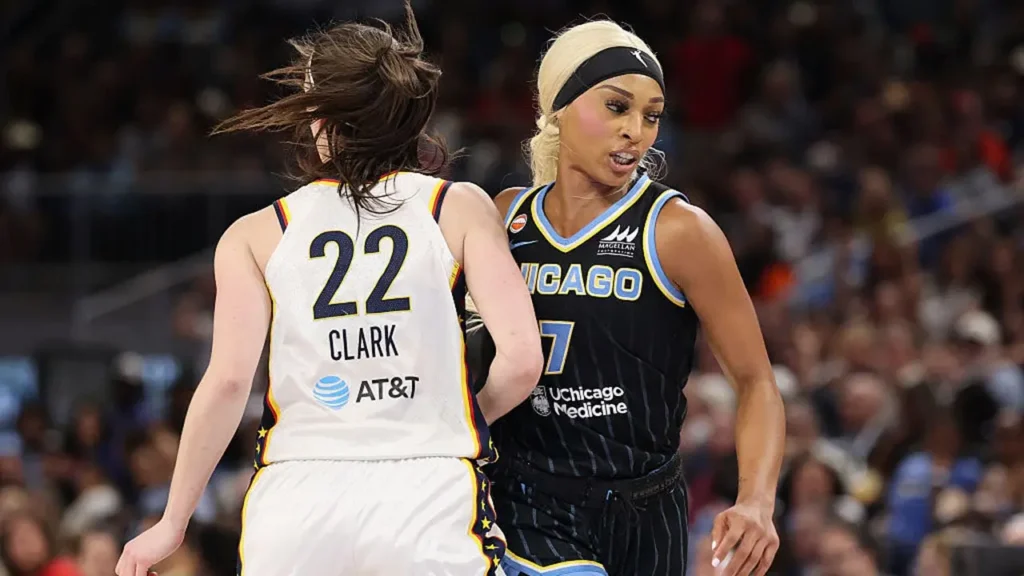
Cindy Brunson, a former ESPN broadcaster with nearly three decades covering women’s professional basketball, has drawn scrutiny for the inconsistency in how she evaluates player performances and achievements. The criticism centers on stark differences in how Brunson discusses Caitlin Clark compared to other prominent WNBA athletes, raising questions about the objectivity of her recent commentary across social media platforms.
The controversy intensified following a Sunday game in which Clark recorded 37 points on 13-of-24 shooting with eight three-pointers and 10 assists as the Fever defeated the Sky 113-90. Brunson dismissed the performance as “stat padding” given the game’s lopsided margin, arguing the accomplishment should be disregarded because the Fever were leading by 20 points with one minute remaining. Notably, Clark did not appear in the Seattle-Dallas game Brunson was discussing when making her comparative argument.
Clark has now accumulated five career games with at least 30 points and 10 assists—more than all other WNBA players combined throughout the league’s 30-year history. When confronted with this achievement, Brunson characterized it as stemming from a “small sample size,” a claim that contradicts the statistical reality that Clark has accomplished this feat more times in under three seasons than the rest of professional women’s basketball history combined.
Brunson applied markedly different standards when evaluating other athletes’ performances in similar circumstances. When Paige Bueckers recorded 22 points and 11 assists in a Dallas Wings victory by 18 points, Brunson praised the effort without mentioning the score differential or competitive imbalance, stating such considerations were “different” in that context.
The commentator also celebrated Angel Reese’s record-breaking 26-rebound performance this week without applying the competitive level scrutiny she used for Clark. When social media users pointed out the blowout margin and opposing bench usage—the identical arguments Brunson had invoked to diminish Clark—she responded that such factors were irrelevant to assessing the achievement.
Brunson’s commentary on the DiJonai Carrington-Sophie Cunningham incident further illustrated her willingness to abandon conventional analysis. She argued that Cunningham, not Carrington, should have been ejected after the clothesline foul, and later posted support for Carrington “all day every day,” suggesting the flagrant 2 call should have been a flagrant 1.
When Brunson deleted her post about Clark’s performance after receiving critical responses, she attributed the removal to “racist” and “transphobic” comments directed at her—a pattern that observers noted repeated the initial aggressor’s narrative shift to claiming victimhood after others questioned her analysis.
The mounting pattern of disparate treatment has prompted observers to question whether Brunson’s coverage reflects honest analysis or reflects underlying personal grievances. Media critics have noted that her treatment of Clark stands in sharp contrast to her celebratory approach toward other players’ accomplishments in similar statistical circumstances.

More Stories
Trump Threatens FCC Action Against NBC’s Welker Over Endorsement Coverage
Looney Tunes’ ‘Coyote vs. Acme’ Debuts With $15.5 Million as ‘Spider-Man’ Holds Box Office Crown
Country Music Legend Dolly Parton Laid to Rest; Niece Shares Touching Remembrance