


💛 A quick favor, if you've got a second.
We're really happy that you chose to read one of our stories and sincerely hope you'll stick around to read more. We took our paywall down — for now — but that won't last forever, and when the gate goes back up, we'd love for you to already be on the inside.
It's free. So please enter your email here and don't forget to like and follow us on all of your favorite Social Media platforms!
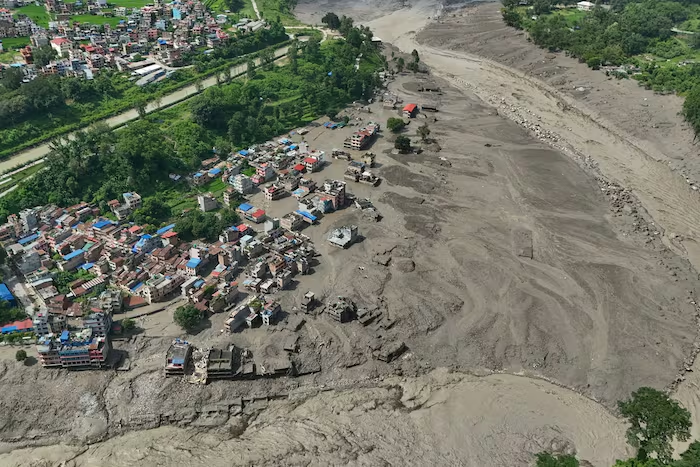
A catastrophic avalanche of ice and rock unleashed devastating flash floods across parts of Nepal on Wednesday, claiming at least eight lives and leaving hundreds unaccounted for in its wake. The disaster wreaked substantial destruction on villages, roads and hydropower infrastructure across multiple districts in the affected region.
Government authorities reported 384 tourists missing following the deluge, encompassing 291 individuals from nations including India, the United States, the United Kingdom and Malaysia. Officials have issued urgent advisories directing residents in several districts to avoid proximity to the Bhotekoshi, Trishuli and Narayani rivers as rescue operations continue.
The Bhotekoshi River overflowed at approximately 9 a.m. Wednesday morning, obliterating infrastructure across its path. Sasmit Pokharel, a Nepali government spokesperson, stated that authorities have appealed to both India and China for assistance in coordinating search and rescue efforts.
The Rasuwa district experienced the most severe impacts, having endured comparable flooding in August of the previous year when glacial melt from Tibet resulted in a glacial lake overflow triggered by elevated mountain temperatures. That incident claimed nine lives and damaged critical infrastructure, including a bridge connecting Nepal and China.
Climate scientists from the Kathmandu-based International Centre for Integrated Mountain Development attributed Wednesday’s flooding to an avalanche originating from a glacier. The Lhende Khola River, a tributary of the Bhotekoshi, experienced the most extreme flooding levels, with researchers noting the river crested twice within fourteen months.
Saswata Sanyal, a disaster risk reduction specialist at the climate research organization, explained that an ice and rock avalanche from a glacier on the Nepal side blocked the river before releasing a sudden downstream surge. He emphasized that early warning systems represent critical adaptation measures in the warming Himalayan environment.
The Himalayan region faces heightened vulnerability to extreme weather phenomena including intense rainfall, flooding and landslides due to accelerated warming outpacing global averages, driven by human-caused climate change. Researchers have documented increasing frequency of heat waves, heavy precipitation events and glacial melting across the region in recent years.
A recent study by the Kathmandu research center found that glaciers spanning the Hindu Kush Himalaya region are retreating at an accelerating pace, with ice loss rates doubling since 2000 primarily as a consequence of rising global temperatures and climate change.

More Stories
Colombia backs Trump security push while limiting U.S. role in anti-gang operations
Federal Prosecutors Convene Special Grand Jury to Investigate D.C. Schools’ Attendance and Graduation Practices
State Department Reissues Level 3 Travel Advisory for Israel Amid Terrorism and Armed Conflict Concerns