

💛 A quick favor, if you've got a second.
We're really happy that you chose to read one of our stories and sincerely hope you'll stick around to read more. We took our paywall down — for now — but that won't last forever, and when the gate goes back up, we'd love for you to already be on the inside.
It's free. So please enter your email here and don't forget to like and follow us on all of your favorite Social Media platforms!
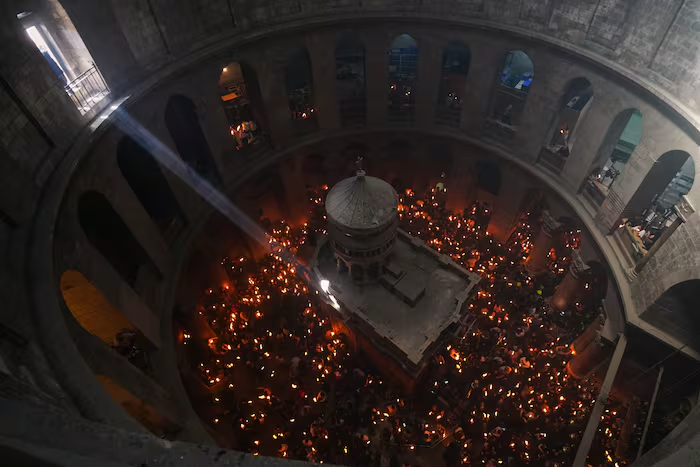
Heavy wooden doors clanged shut and bolts were secured from outside, trapping a journalist along with priests, nuns and pilgrims within one of Christianity’s most revered locations in Jerusalem’s Old City. The Church of the Holy Sepulcher marks the site where Christians believe Jesus was crucified, buried and resurrected, drawing worshippers from around the world seeking spiritual connection to these foundational moments of their faith.
A representative from a Muslim family—custodians of the basilica’s keys since the 13th century—locked the entrance from outside, climbing a wooden ladder to reach the upper bolt. The same ritual unseals the structure at dawn, creating a nightly cycle where approximately a dozen priests, registered pilgrims and several cats inhabit the sprawling stone complex alone from 9 p.m. until morning.
The Armenian Apostolic, Catholic and Greek Orthodox churches jointly oversee the worship space, an arrangement refined over centuries as various rulers controlled the region. This shared governance extends to designated altars and three primary veneration sites: the stone of unction where Jesus’s body was prepared, the Holy Edicule shrine marking his tomb, and the Calvary chapel housing the stone where his cross stood according to Christian tradition.
Peter Stängle, a pilgrim from Brazil, chose to spend the night in prayer rather than navigate the daytime crowds diminished by the COVID-19 pandemic, the Israel-Hamas war and regional conflicts. He knelt repeatedly at the unction stone, reflecting on spiritual questions while the labyrinthine medieval structure—largely constructed in the Middle Ages on sites venerated since the fourth century—echoed with his contemplation.
Midnight services commence after bell-ringing, with resident clergy conducting liturgies that typically conclude around 6 a.m., when overnight visitors depart and daytime worshippers enter. The Franciscan order, residing in rooms above the Catholic section, has maintained continuous presence for 700 years, with Rev. Giuseppe Gaffurini describing the experience as transformative despite his earlier monastic training.
Multiple Christian rites rotate through the sacred spaces in careful coordination, with Greek Orthodox, Armenian, Coptic, Ethiopian and Syrian Orthodox clergy following a controversial 19th-century arrangement governing their access and worship times. This collaborative arrangement marks a departure from centuries of violent conflicts over worship rights, representing what leaders describe as an unusually positive period of interfaith cooperation.
Rev. Francesco Ielpo, the Franciscan Custos overseeing more than 300 friars across the Holy Land region, characterizes this cooperation as essential peacemaking testimony. He emphasized that the current harmony among denominations signals genuine prophetic commitment to peace within and beyond the sacred structure.
Before recent conflicts intensified, narrow surrounding alleyways teeming with pilgrims created shoulder-to-shoulder crowds that often prevented entry into the stone courtyard itself. The isolation of nighttime provides contemporary worshippers solitude with their faith at the very location central to Christianity’s core beliefs about crucifixion and resurrection.

More Stories
Colombia backs Trump security push while limiting U.S. role in anti-gang operations
Trump Threatens FCC Action Against NBC’s Welker Over Endorsement Coverage
Federal Prosecutors Convene Special Grand Jury to Investigate D.C. Schools’ Attendance and Graduation Practices