


💛 A quick favor, if you've got a second.
We're really happy that you chose to read one of our stories and sincerely hope you'll stick around to read more. We took our paywall down — for now — but that won't last forever, and when the gate goes back up, we'd love for you to already be on the inside.
It's free. So please enter your email here and don't forget to like and follow us on all of your favorite Social Media platforms!
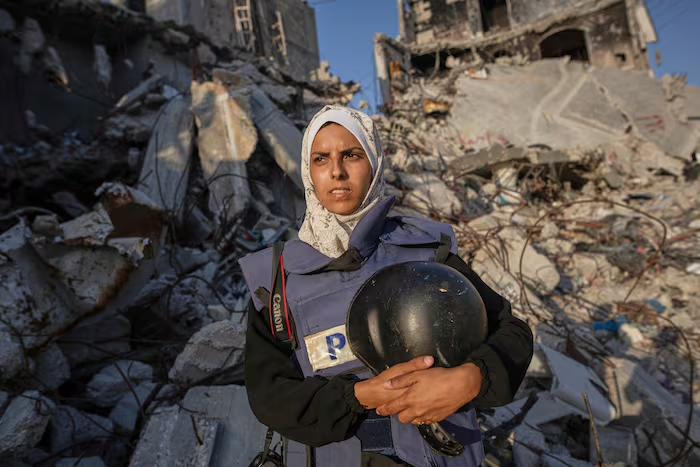
Twelve months have passed since an Israeli military operation at Nasser Hospital in Gaza resulted in the deaths of 22 Palestinians, among them Reuters cameraman Hussam al-Masri and visual journalist Mariam Dagga, who contributed to The Associated Press and other news organizations. Despite mounting pressure from AP and international rights groups, no military personnel have been held responsible for the Aug. 25, 2025, strike, and the Israeli army has declined to release investigation details or a completion timeline.
Israeli military leadership initially characterized the operation as targeting a suspected Hamas camera positioned on the hospital roof. The military later asserted that six of those killed had links to Hamas, though it provided no substantiating evidence for these claims. An anonymous Israeli soldier with direct knowledge of military discussions now contradicts this narrative, stating that investigators found no evidence connecting al-Masri’s camera to Hamas and that none of the six individuals named as militants were actual targets of the strike.
The operation unfolded in two phases. The initial strike killed al-Masri and one other person. As journalists and rescue workers ascended an external staircase to aid the wounded and document the incident, the military conducted a second strike that killed 20 additional people, with no evidence suggesting any were armed. The hospital sustained four separate strikes using high-explosive tank ammunition in total.
The Israeli military told AP that examination of the incident continues and findings will be transferred to the Military Advocate General’s Corps to determine whether a criminal investigation should be opened. The military did not respond to detailed questions about specific allegations or provide a projected timeline for conclusions.
AP’s analysis of Israeli claims has revealed inconsistencies. One of the six individuals Israel identified as Hamas-linked does not appear on the hospital’s casualty records, while two others were identified as medical or emergency personnel. Israeli officials justified the camera designation by citing “suspicious behavior,” specifically a towel covering the lens and the cameraman’s positioning, which al-Masri’s colleagues confirm was standard practice to protect equipment from sun and dust exposure in Gaza’s climate.
An anonymous former military official and the soldier with insider knowledge revealed that a high-ranking army commander initially approved a precision weapon to eliminate the camera. When an unmanned drone operation failed for undisclosed reasons, the division commander authorized an alternative approach involving tank rounds, which inflict substantially greater civilian casualties than drone strikes. The decision-making process and authority levels for this significant tactical shift remain unclear.
Oded Ailam, former head of Israel’s Mossad counterterrorism division, stated that while field commanders retain operational discretion, they do not have unlimited authority. “If the change is significant, particularly where it may affect the risk to civilians, it must remain within the authority, rules and intent of the original order, or require renewed approval,” Ailam said.
Breaking the Silence, an organization of Israeli military veterans critical of Israeli policies in Palestinian territories, shared the soldier’s testimony and stated its own sources corroborated his account. The group asserts that the military employs a “retroactive incrimination process” in which killed Palestinians are automatically classified as militants regardless of evidence or their status as armed combatants. Executive Director Nadav Weiman characterized this practice as a “near automatic justification for every bullet, shell or missile fired, and as a tool used to avoid carrying out real investigations.”
AP Executive Editor Julie Pace expressed continuing distress over the deaths and frustration with Israeli authorities’ lack of transparency. “A year later, we remain devastated by their deaths and are still searching for answers from the Israeli authorities about what happened that day. The information we have received to date has fallen short of the clear answers and accountability that an incident of this gravity requires,” Pace said.
According to the Committee to Protect Journalists, Israeli military operations in Gaza have killed 207 Palestinian reporters since Hamas’ Oct. 7, 2023, attack initiated the conflict. Israel has prohibited foreign journalists from entering Gaza, placing Palestinian reporters in a critical role documenting the war. CPJ’s Middle East and North Africa director Sara Qudah emphasized that accountability gaps undermine press freedom. “When journalists can be killed without credible accountability, it becomes harder and more dangerous for the press to document conflicts and for the public to know what is happening,” she said.
Last week, the Israeli military announced criminal investigations into two additional high-profile incidents: the 2024 death of 5-year-old Hind Rajab and her family, and the 2025 killing of 15 paramedics. The military cleared troops in three separate incidents involving deaths of international aid workers.
Families of the victims continue searching for answers. Hussam al-Masri’s brother, Ezz al-Din al-Masri, expressed bewilderment at his sibling’s death. “Unfortunately, we found that the blood of journalists in Gaza is cheap … as if the rules protecting journalists do not apply to them,” he said. Mariam Dagga’s father, Riyad Abu Dagga, visits his daughter’s grave carrying her phone and camera, items she never separated from during her work, and frequents her apartment near Nasser Hospital, where he grieves. “Had any of the daughters of the soldiers been killed unjustly, they would not have stayed silent. They would want to know why,” he said.

More Stories
Federal voting arrest in New Jersey adds new pressure point in Sherrill-Trump standoff
Colombia backs Trump security push while limiting U.S. role in anti-gang operations
Packers Running Back Josh Jacobs Placed on NFL Commissioner’s Exempt List Following Domestic Arrest