

💛 A quick favor, if you've got a second.
We're really happy that you chose to read one of our stories and sincerely hope you'll stick around to read more. We took our paywall down — for now — but that won't last forever, and when the gate goes back up, we'd love for you to already be on the inside.
It's free. So please enter your email here and don't forget to like and follow us on all of your favorite Social Media platforms!
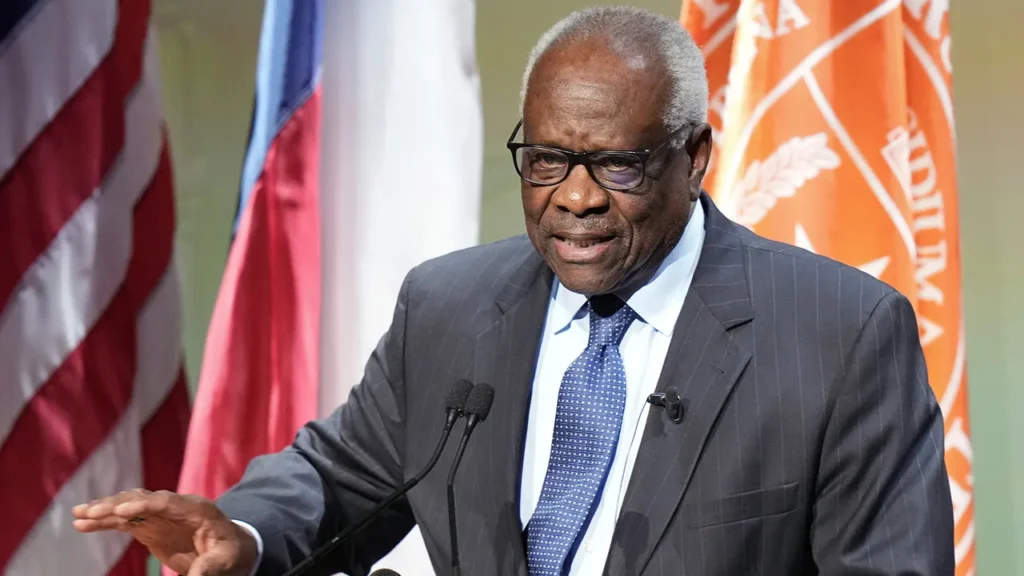
Supreme Court Justice Clarence Thomas pushed back against the notion that African Americans must adopt particular political positions simply because of their race during a conversation with Republican Texas Senator Ted Cruz on the latter’s podcast. Thomas recalled a phrase from his past that encapsulated his resistance to such expectations, saying he had rejected mandates tied to skin color that dictated how he should think. He characterized this refusal as leading some to view him as contradictory for departing from prescribed ideological positions.
The justice’s trajectory from his impoverished upbringing in segregated Georgia to his current conservative jurisprudence illustrates the intellectual journey he described. Raised speaking Gullah in Pin Point before relocating to Savannah with his grandparents, Thomas initially embraced left-wing Black nationalism during his college years at the College of the Holy Cross. A violent 1970 protest in Cambridge, Massachusetts, prompted him to reconsider activism and turn toward the self-reliance philosophy his grandfather had instilled in him.
To illustrate his argument, Thomas drew an explicit comparison between efforts to constrain Black political thought and the restrictions of Jim Crow-era segregation. He posed a series of hypothetical scenarios about the segregated Savannah Public Library, each progressively restricting access to different sections and materials. Thomas concluded by questioning why intellectual restrictions based on race should be viewed differently than the physical segregation he experienced as a child.

More Stories
Federal voting arrest in New Jersey adds new pressure point in Sherrill-Trump standoff
Colombia backs Trump security push while limiting U.S. role in anti-gang operations
Former NFL cheerleader and ex-aide face off in close Rhode Island GOP primary