


💛 A quick favor, if you've got a second.
We're really happy that you chose to read one of our stories and sincerely hope you'll stick around to read more. We took our paywall down — for now — but that won't last forever, and when the gate goes back up, we'd love for you to already be on the inside.
It's free. So please enter your email here and don't forget to like and follow us on all of your favorite Social Media platforms!
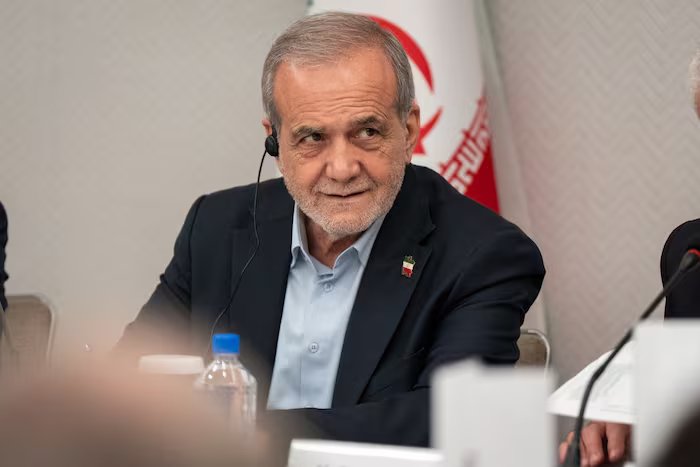
Iranian President Masoud Pezeshkian characterized a recently signed memorandum of understanding with the United States as the country’s optimal path out of what he termed a state of “neither war nor peace.” In remarks distributed by state media early Sunday, Pezeshkian argued that members of Iran’s Supreme National Security Council viewed the accord as the strongest achievable agreement consistent with national dignity and interest. The president explicitly rejected characterizations of the deal as a surrender, noting that Iran’s supreme leader continues to set national policy.
The memorandum, signed by President Donald Trump in June, established a 60-day window for negotiating an end to hostilities and resolving nuclear issues between the nations. That deadline expired last week with the two sides remaining substantially apart, particularly on the question of reopening the Strait of Hormuz, a critical waterway for global commerce. Pezeshkian linked the agreement to Iran’s economic recovery, asserting that the country cannot secure investment while political uncertainty persists.
The Iranian economy has deteriorated significantly during nearly six months of conflict, with sanctions and naval blockades severely hampering oil exports, the nation’s primary revenue source. Pezeshkian emphasized that capital flows remain sensitive to geopolitical risk and that removing such uncertainty was essential for national prosperity.
Pakistan’s military leadership announced plans to visit Tehran on Monday as part of efforts to deepen bilateral cooperation and advance regional stability, according to Iranian state television. The delegation, led by Field Marshal Asim Munir, will arrive following discussions with Iran’s foreign minister. Pakistan has previously undertaken multiple mediation initiatives aimed at resolving the Iran conflict.
Iran’s newly appointed security chief issued stern warnings against neighboring countries joining the Trump administration’s economic campaign against Tehran. Mohsen Rezaei, recently named to lead the Supreme National Security Council, threatened “seismic” retaliation if regional states participate in what he described as economic warfare. Rezaei specifically referenced oil shipping corridors in the Persian Gulf as potential targets, declaring that any neighboring nation supporting such measures would be considered hostile.
Trump has pledged to intensify economic pressure on Iran through what he called “unprecedented” sanctions and isolation tactics. Iran has already endured stringent international sanctions for years.
In the occupied West Bank, a Palestinian man reported being struck with a pipe by an Israeli settler outside his residence Saturday afternoon. The 61-year-old victim, Saeed Muhammad Ibrahim Rabah, sustained bruising and pain in the incident involving two settlers who arrived with a tractor. Rabah characterized the attack as an attempt to force Palestinians from their land.
Rabah disclosed that he lost a leg in April 2025 after confronting settlers on his property, when one fired shots into the air before shooting him in both legs. He subsequently underwent amputation and has remained at his home despite the incident.
Separately, Israeli forces pursued a suspect in a stabbing attack that wounded a 24-year-old Israeli man near al-Auja in the eastern West Bank. Emergency responders transported the victim to a hospital in moderate condition. Violence in the West Bank has intensified substantially, with Palestinian officials reporting at least 87 Palestinian deaths from approximately 1,500 attacks by Israeli settlers and soldiers in 2026, while three Israelis have been killed by Palestinians during the same period.

More Stories
Federal voting arrest in New Jersey adds new pressure point in Sherrill-Trump standoff
Colombia backs Trump security push while limiting U.S. role in anti-gang operations
Former NFL cheerleader and ex-aide face off in close Rhode Island GOP primary