


💛 A quick favor, if you've got a second.
We're really happy that you chose to read one of our stories and sincerely hope you'll stick around to read more. We took our paywall down — for now — but that won't last forever, and when the gate goes back up, we'd love for you to already be on the inside.
It's free. So please enter your email here and don't forget to like and follow us on all of your favorite Social Media platforms!
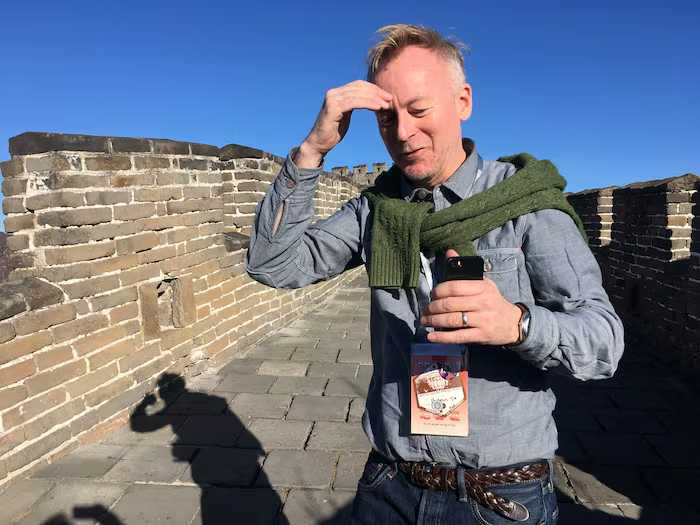
Christopher Bodeen, an accomplished international correspondent who spent more than two decades documenting China’s transformation into a global economic and military power for The Associated Press, died Monday. He was 55. His death followed a prolonged battle with cancer and complications from a stroke, his daughter Ingrid confirmed Thursday from Taiwan.
A fluent Mandarin speaker with a distinctive Taiwan accent, Bodeen became the AP’s foremost authority on Beijing’s political machinations and military developments while based in Shanghai, Beijing and Taipei. Colleagues recalled his capacity to quickly decipher the significance of opaque government pronouncements and translate them for international audiences navigating the complexities of modern China.
His reporting demonstrated exceptional resourcefulness during crises. After the 2008 Sichuan earthquake devastated the region, Bodeen filed his initial account piece by piece via text messages when traditional communication infrastructure had collapsed, providing some of the world’s first reliable eyewitness observations of the disaster. Charles Hutzler, a former AP Beijing bureau chief, described the effort as pioneering coverage of one of the era’s most catastrophic natural disasters.
Bodeen joined the AP in 1996 as a Taiwan-based reporter before transitioning to editorial roles at the New York international desk and later moving to Beijing as a full correspondent in 2000. A Tufts University graduate with degrees in history and Asian studies, he was born in Missouri on September 9, 1970, and spent formative years across the Middle East, Europe, Africa and Asia, where his parents worked in diplomatic service.
Colleagues highlighted Bodeen’s distinctive approach to reporting from restrictive environments. During the 2001 incident involving a forced-down American Air Force plane near Hainan Island, Bodeen concealed himself in remote hills to investigate the story, demonstrating the determination that defined his career. Video journalist Raf Wober remembered him as an ideal reporting partner for dangerous assignments.
Beyond his hard news coverage, Bodeen brought analytical sophistication and dry wit to his writing. In a 2017 examination of state media promotion of Xi Jinping, he chronicled “more than four minutes of uninterrupted clapping” on state television and described a Russian translator allegedly so absorbed in studying Xi’s speeches that he skipped meals to complete them. Yet Bodeen carefully contextualized such propaganda, noting that Xi’s omnipresent image recalled darker historical parallels to Mao Zedong’s deity-like veneration during the Cultural Revolution.
Colleagues consistently remarked on Bodeen’s encyclopedic knowledge of Asian affairs, his infectious passion for journalism and his ability to transform conversations into informal history lessons. Emily Wang Fujiyama, former Greater China news director, noted his facility jumping between topics—from South China Sea military positioning to Taiwan’s political intricacies to the sensitivities surrounding Tibet and Mongolia—with equal expertise.
Those who worked with Bodeen remembered his Boston Red Sox fandom, eclectic taste in punk rock, sharp comedic timing and deep knowledge of 1970s and 1980s film and television comedies. Kanis Leung, an AP Hong Kong reporter, recalled Bodeen’s favorite quip about journalism as an ancient correspondent’s metaphor for condensing vast information into compact stories—though he employed considerably earthier language than the sanitized version.
Bodeen maintained fierce dedication to both his profession and his family. Colleagues noted his visible pride in his daughters’ accomplishments and artwork, while his daughter Ingrid remembered him requesting homework and spelling lists during extended Afghan reporting assignments to study alongside her despite geographic separation. He never missed a spelling test week, she said.
Bodeen is survived by his wife, Yen Ling; daughters Ingrid, 26, and Naomi, 22; his parents; and a sister.

More Stories
Colombia backs Trump security push while limiting U.S. role in anti-gang operations
Trump Threatens FCC Action Against NBC’s Welker Over Endorsement Coverage
Federal Prosecutors Convene Special Grand Jury to Investigate D.C. Schools’ Attendance and Graduation Practices