


💛 A quick favor, if you've got a second.
We're really happy that you chose to read one of our stories and sincerely hope you'll stick around to read more. We took our paywall down — for now — but that won't last forever, and when the gate goes back up, we'd love for you to already be on the inside.
It's free. So please enter your email here and don't forget to like and follow us on all of your favorite Social Media platforms!
Tuesday’s primary contests across multiple states, including Florida, Alaska, Wyoming and California, have begun shaping the landscape for this year’s midterm elections as Republicans maintain a narrow advantage in Congress. The results demonstrated sharp divisions within both major parties while producing several unexpected outcomes that will influence fall campaigns.
Florida Democrats handed a stunning defeat to retired Army Lt. Col. Alex Vindman, a former National Security Council official who testified against President Trump during his 2019 impeachment trial. Despite Vindman’s overwhelming financial advantage—outspending progressive state lawmaker Angie Nixon by more than 16-to-1—Nixon secured an easy victory in the primary and will now challenge Sen. Ashley Moody for the final two years of Marco Rubio’s Senate term.
In a separate South Florida contest, U.S. Rep. Jared Moskowitz prevailed over union organizer and democratic socialist Oliver Larkin in his bid to retain his House seat in a newly redrawn Republican-friendly district.
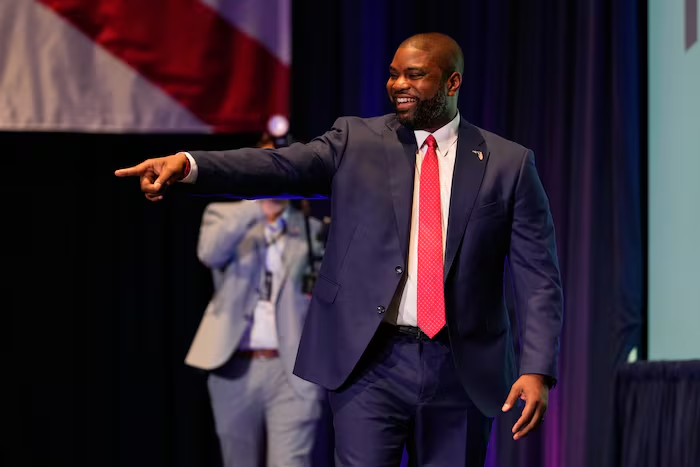
Republican Rep. Byron Donalds won his party’s gubernatorial nomination in Florida, positioning himself to become the state’s first Black governor. His victory is part of a historic wave of Black candidates seeking governorships nationwide, including Republicans John James in Michigan and Lisa Demuth in Minnesota, who defeated conspiracy theorist Mike Lindell, and multiple Democratic contenders across several states.
Donalds will face Democrat David Jolly, a former Republican who switched parties, in the general election. Currently, Democrat Wes Moore of Maryland stands as the nation’s only Black governor.
U.S. Rep. Debbie Wasserman Schultz decisively won a contentious South Florida House race despite controversy surrounding her decision to run in a plurality-Black district. Her victory over U.S. Rep. Sheila Cherfilus-McCormick, who had resigned amid federal indictment and ethics complaints, sparked accusations of party disloyalty among some Democratic rivals.
Trump-endorsed Republican Catalina Lauf lost her bid for a Florida House seat to conservative radio station owner Jim Schwartzel. The race featured an unusual assemblage of candidates, including two former congressmen attempting comebacks after personal scandals and an actor convicted for his role in the January 6 Capitol assault.
Former North Carolina Rep. Madison Cawthorn, whose tenure ended amid traffic violations and airport gun incidents, and former New York Rep. Chris Collins, who served prison time for insider trading before receiving a Trump pardon, both competed in the crowded field.
Republican Rep. Cory Mills lost his reelection bid to former television reporter Ryan Elijah despite Trump’s initial endorsement. Mills faced domestic violence allegations and had been abandoned by Florida Gov. Ron DeSantis and other state Republicans.
Alaska’s Senate primary created potential confusion as two candidates named Dan Sullivan appeared on the ballot. Republican incumbent Sen. Dan Sullivan and Daniel J. Sullivan Jr., a retired teacher, both advanced under the state’s open primary system, though Republicans alleged the second Sullivan was a Democratic sham candidate—a claim he denied.
In Wyoming’s gubernatorial primary, Trump-endorsed State Superintendent Megan Degenfelder lost to state Sen. Eric Barlow, a U.S. Marine veteran and livestock veterinarian. However, Trump’s preferred Senate candidate, Rep. Harriet Hageman, easily secured the Republican nomination for the seat being vacated by retiring Sen. Cynthia Lummis.
California voters advanced two candidates from a special open primary for the Bay Area House seat vacated by Democratic Rep. Eric Swalwell, who resigned following sexual assault allegations. State Sen. Aisha Wahab and BART Board President Melissa Hernandez progressed from the race, which featured substantial spending by pro-Israel lobbying groups opposed to Wahab.

More Stories
Colombia backs Trump security push while limiting U.S. role in anti-gang operations
Former NFL cheerleader and ex-aide face off in close Rhode Island GOP primary
Chicago Mayor Issues Executive Order Requiring Contractor Diversity Disclosures and ICE Ties Reporting