


💛 A quick favor, if you've got a second.
We're really happy that you chose to read one of our stories and sincerely hope you'll stick around to read more. We took our paywall down — for now — but that won't last forever, and when the gate goes back up, we'd love for you to already be on the inside.
It's free. So please enter your email here and don't forget to like and follow us on all of your favorite Social Media platforms!
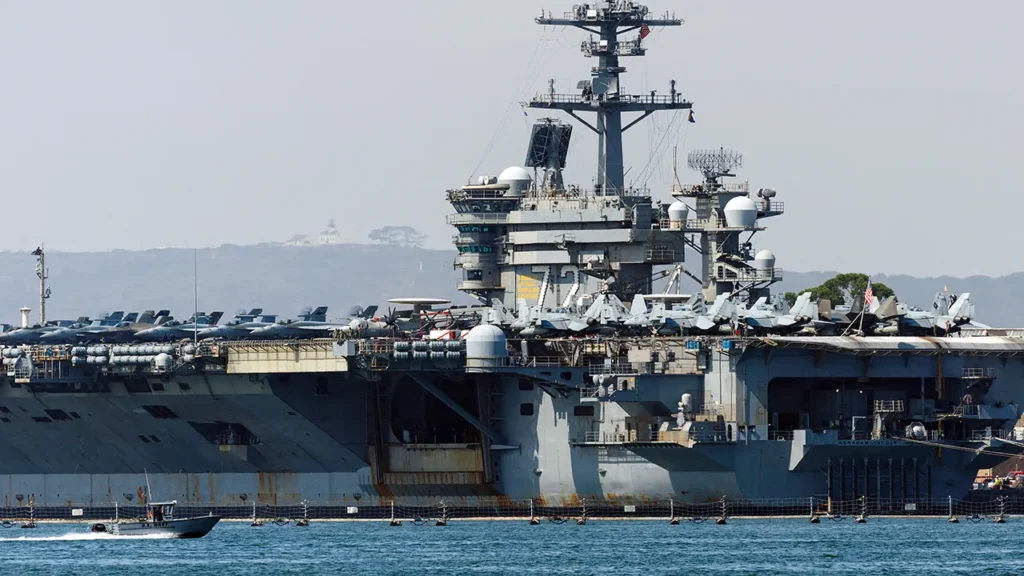
The decision to send the USS George Washington to the Middle East to relieve the USS Abraham Lincoln—which has surpassed 260 days of deployment, including more than 240 consecutive days at sea—signals a fundamental military tradeoff for Washington. The carrier rotation means the Pacific will operate without a dedicated U.S. carrier for an undetermined stretch, raising questions about America’s ability to maintain deterrence across multiple theaters simultaneously.
Military planners face a mounting strategic dilemma: the United States can maintain sufficient force to sustain operations against Iran while simultaneously deterring China from attacking Taiwan, yet doing so requires careful allocation of finite resources. With more than 50,000 American service members now operating across the Middle Eastern region, ships, aircraft, munitions and command attention that could otherwise strengthen Indo-Pacific positioning are committed elsewhere.
The 2026 National Defense Strategy explicitly identifies containing China and defending the First Island Chain as top Pentagon priorities, yet current force allocation patterns suggest these stated objectives may not drive actual resource deployment decisions. The central question confronting policymakers is whether emergency Middle Eastern commitments, stretched across months, are consuming military capacity needed to convince Beijing that attacking Taiwan would prove too costly.
History provides cautionary precedent. Britain’s inability to reinforce Singapore before Japan’s February 15, 1942 invasion resulted from accumulated commitments across multiple theaters that stretched naval resources beyond sustainable limits. By contrast, Roosevelt and Churchill maintained strategic discipline during World War II, prioritizing Germany’s defeat while continuing Pacific operations, demonstrating that effective strategy requires distinguishing principal threats from immediate ones.
Naval forces make these tradeoffs particularly visible and permanent. A carrier assigned to Middle Eastern operations cannot simultaneously project power in the Pacific; airpower offers greater flexibility through rapid repositioning, but support infrastructure, tankers, bases and munitions cannot shift with comparable speed. The Lincoln’s extended deployment has prompted congressional scrutiny regarding crew strain and vessel readiness, yet necessary rotations inherently carry strategic costs.
Building additional carriers offers no quick solution. Shipbuilding capacity limitations, maintenance backlogs and munitions production constraints present decade-long challenges, meaning Pentagon strategy must work with currently available forces rather than anticipated future capabilities. The question Washington must confront is not whether the nation possesses sufficient military power overall, but whether available resources are distributed to match declared priorities.
As the Iran conflict extends beyond six months, the broader calculation becomes urgent: what does each successive Middle Eastern surge cost America’s capacity to execute its wider defense strategy? Resolving this requires enforcing priorities that policymakers often resist—identifying which American interests are vital, which regional partners can assume greater responsibility, and what level of Pacific deterrence risk Washington accepts with each new commitment.
The Truman administration faced analogous pressures when North Korea invaded in June 1950, yet maintained focus on the larger Soviet competition even while committing combat forces to the peninsula. That disciplined approach demonstrates that addressing immediate crises need not preclude attention to broader strategic competition. Washington now faces whether it can demonstrate comparable strategic clarity regarding Iran and China, or whether competing demands will gradually erode coherent defense strategy.

More Stories
Colombia backs Trump security push while limiting U.S. role in anti-gang operations
Chicago Mayor Issues Executive Order Requiring Contractor Diversity Disclosures and ICE Ties Reporting
Federal Prosecutors Convene Special Grand Jury to Investigate D.C. Schools’ Attendance and Graduation Practices