💛 A quick favor, if you've got a second.
We're really happy that you chose to read one of our stories and sincerely hope you'll stick around to read more. We took our paywall down — for now — but that won't last forever, and when the gate goes back up, we'd love for you to already be on the inside.
It's free. So please enter your email here and don't forget to like and follow us on all of your favorite Social Media platforms!
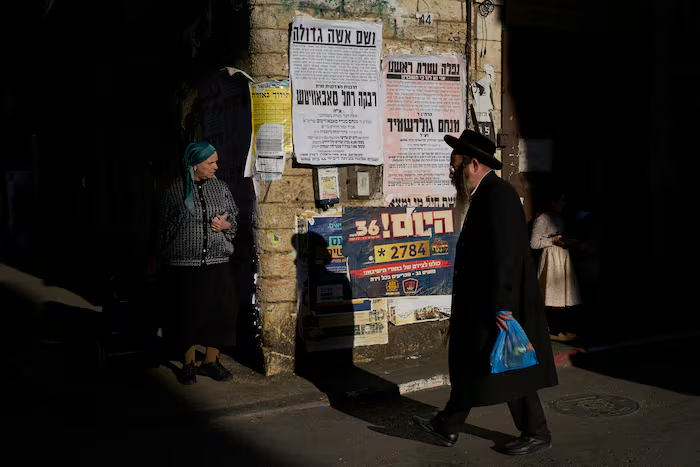
Ultra-Orthodox Jewish communities represent a visibly distinctive and rapidly expanding segment of Israeli society, characterized by distinctive dress codes and large families. Their increasing numbers and political influence have generated substantial friction with both religious and secular Israelis, creating deepening divisions across the nation. The tension centers on a longstanding exemption from mandatory military service that has become a flashpoint as Israel enters its third year of conflict on multiple fronts.
At the heart of ultra-Orthodox ideology lies the conviction that intensive study of sacred Jewish texts constitutes the paramount religious obligation, superseding employment and military service even during wartime. Judith Rosenblum, a mother of eight, acknowledges that secular pressures threaten ultra-Orthodox traditions, yet concedes that three of her sons enlisted following the October 7, 2023 Hamas attack on Israel. She maintains that while full-time religious scholarship remains the ideal, those who pursue military service fulfill an essential national duty and become “amazing human beings.”
The term “Haredim,” applied to ultra-Orthodox Jews in Hebrew, derives from the Prophet Isaiah’s reference to those “fearful or astounded by the word of God,” according to Rabbi Beryl Gershenfeld. Religious seminaries, or yeshivas, function as foundational institutions where young men aged 17 and older dedicate themselves to intensive prayer and textual analysis. Rabbi Heshy Grossman describes these residential schools as “the beating heart of the community,” where students in formal attire spend entire days immersed in study and discussion of religious commentaries.
Twenty-two-year-old Etl Lovy, nearing completion of five years of yeshiva study, describes his daily routine beginning at 7 a.m. with prayer and continuing through evening study sessions. He credits every aspect of his existence, from consuming water to achieving spiritual growth, to divine guidance. The ultra-Orthodox framework reserves more comprehensive secular education for women, who are expected to work and sustain large families while adhering to religious teachings regarding family planning.
Rabbi Emanuel Feldman, in his late 90s and a longtime contributor to ultra-Orthodox publications, contends that abandoning Torah study leads to cultural assimilation and loss of Jewish identity. He asserts that the ultra-Orthodox community respects civil law except where religious practice faces restriction or interference. Feldman warns that without sustained religious commitment, “you become like any other Mediterranean country.”
Following the Holocaust’s devastation of Torah scholarship, Israel’s founders granted ultra-Orthodox scholars special protections to rebuild their traditions, including military draft exemptions originally affecting hundreds of scholars. Subsequent conservative governments expanded this exemption to encompass all pursuing full-time religious study. Shlomit Ravitsky Tur-Paz of the Israel Democracy Institute estimates the ultra-Orthodox population will reach approximately 25 percent of Israelis by 2050 and 40 percent of draft-eligible males.
Ravitsky Tur-Paz explains that non-ultra-Orthodox Israelis increasingly resent bearing disproportionate civic burdens, including extended military reserve obligations and tax-funded welfare supporting those choosing religious study over employment. This concern has evolved into the nation’s dominant political flashpoint. Only fewer than 10 percent of ultra-Orthodox men reaching age 18 enlist, typically in separate units accommodating religious observance.
Israeli Army Chief of Staff Lt. Gen. Eyal Zamir recently denounced draft exemptions as “inconceivable” given soldiers’ current “unprecedented sacrifice,” with approximately 1,000 troops killed fighting Hamas in Gaza and Hezbollah in Lebanon since October 2023. Most ultra-Orthodox rabbis maintain their categorical opposition to military conscription, arguing it would “dilute piety” during a formative life stage. Other Israeli men serve nearly three years; women serve two years.
Lovy acknowledged he prays constantly for military personnel but expressed no personal reservations about exemption from service. He stated unequivocally: “We don’t apologize. I’m doing what God wants.” This stance reflects the ultra-Orthodox conviction that religious obligation supersedes all other considerations, including national defense needs during active warfare.
More Stories
Federal voting arrest in New Jersey adds new pressure point in Sherrill-Trump standoff
Colombia backs Trump security push while limiting U.S. role in anti-gang operations
Former NFL cheerleader and ex-aide face off in close Rhode Island GOP primary