


💛 A quick favor, if you've got a second.
We're really happy that you chose to read one of our stories and sincerely hope you'll stick around to read more. We took our paywall down — for now — but that won't last forever, and when the gate goes back up, we'd love for you to already be on the inside.
It's free. So please enter your email here and don't forget to like and follow us on all of your favorite Social Media platforms!
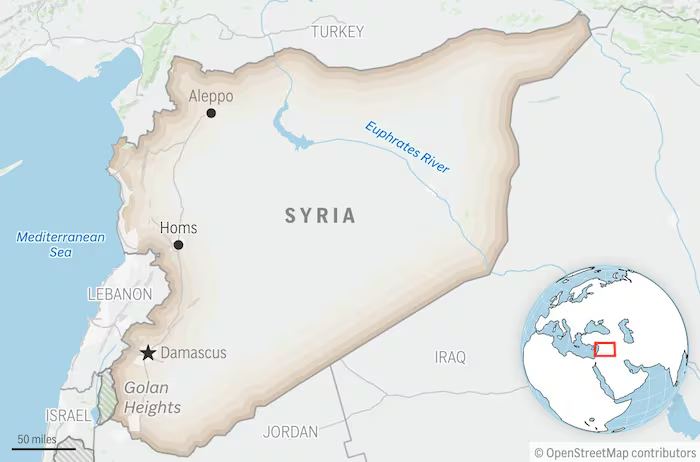
The death of a 29-year-old Syrian detainee has ignited fresh concerns about torture and mistreatment in the country’s prisons, drawing painful parallels to abuses documented during former President Bashar Assad’s rule. Mohammad Ghamira died Sunday at a Latakia hospital following his release from detention, with officials and family members attributing his death to injuries sustained while in police custody. The case has prompted demonstrations and social media activism as Syrians demand answers about what transpired during his arrest days earlier.
Ghamira, a father of two and former volunteer with the White Helmets civil defense organization, suffered from hemophilia, a blood-clotting disorder. His uncle stated that police were informed of his medical condition and warned against physical violence, yet Ghamira was struck while detained at the al-Haffah police station. Syria’s Minister of Emergency and Disaster Management Raed al-Saleh, himself a former White Helmets leader, said the detainee died from complications caused by cerebral and gastrointestinal hemorrhaging resulting from the beating.
Ghamira was arrested on suspicion of theft, according to a statement from Latakia’s internal security command, which provided no additional detail about the allegations. The interim government of President Ahmad al-Sharaa has ordered an investigation, with seven interior ministry personnel detained for questioning. Interior Ministry spokesperson Noureddine al-Baba acknowledged “shortcomings and deficiencies” in some police departments while characterizing other units as performing “exceptional” work.
Human rights organizations contend that Ghamira’s death represents a broader pattern rather than an isolated incident. A U.N. Commission of Inquiry documented torture and mistreatment across 30 detention facilities between January and October 2025, cataloging beatings, electric shocks, mock executions, and sexual violence. Syrians for Truth and Justice reported that severe beatings, electric shocks, and deaths in custody persist under multiple security actors, though the group found no evidence of a centralized torture system equivalent to Assad’s apparatus.
Advocacy groups representing families of disappeared detainees expressed alarm that abusive practices documented under Assad appear to be recurring under the new administration. Families for Freedom stated that Ghamira’s death “reopens the wounds of torture and death in detention for thousands of Syrian families” and warned that such patterns cannot be tolerated as the country attempts to move forward.

More Stories
Federal voting arrest in New Jersey adds new pressure point in Sherrill-Trump standoff
Colombia backs Trump security push while limiting U.S. role in anti-gang operations
Packers Running Back Josh Jacobs Placed on NFL Commissioner’s Exempt List Following Domestic Arrest