


💛 A quick favor, if you've got a second.
We're really happy that you chose to read one of our stories and sincerely hope you'll stick around to read more. We took our paywall down — for now — but that won't last forever, and when the gate goes back up, we'd love for you to already be on the inside.
It's free. So please enter your email here and don't forget to like and follow us on all of your favorite Social Media platforms!
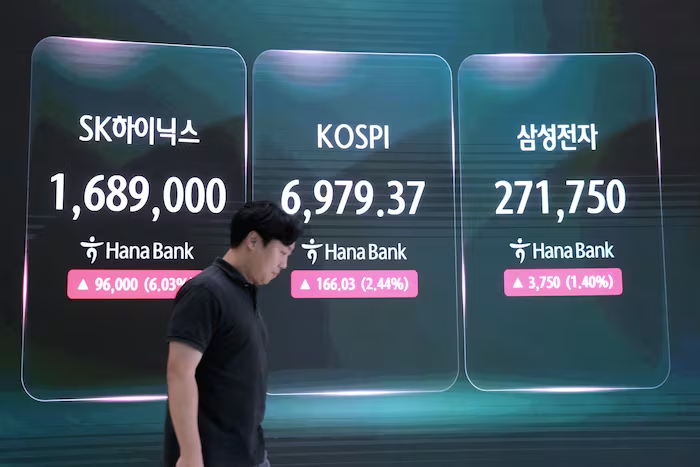
Most Asian equity markets retreated Friday as U.S. index futures remained flat in the wake of July inflation figures that surprised analysts with stronger-than-anticipated improvement. Oil traded with minimal movement following recent weakness, and currency markets remained volatile amid shifting economic expectations.
Regional performance was mixed across major bourses. Tokyo’s Nikkei 225 managed a modest gain of 0.3% to close at 68,533.85, while South Korea’s Kospi advanced 1.3% to 6,924.74. Hong Kong’s Hang Seng lost ground, falling 1% to 25,137.87, and Shanghai’s Composite index declined 0.5% to 3,908.05. Australia’s S&P/ASX 200 dropped 1.1% to 9,090.90, Taiwan’s Taiex slipped 0.2%, and India’s Sensex fell 0.5%.
Wall Street’s Thursday session reflected optimism about slowing price pressures after wholesale inflation data showed a 4.7% year-over-year increase in July, a notable improvement from June’s 5.5% rate and marginally below economist forecasts. The S&P 500 climbed 0.7% to an all-time closing record of 7,798.99, the Dow Jones Industrial Average added 0.1% to 53,839.99, and the Nasdaq composite rose 0.8% to 26,803.03.
Market sentiment shifted as inflation trends suggest the Federal Reserve may postpone further interest rate hikes, marking a potential pause in a rate-increase cycle lasting more than three years. Stephen Innes of SPI Asset Management noted that “the disinflation ducks are starting to line up, and with oil also backing off, the market has steadily stripped away the case for another near-term Fed hike.”
Crude oil retreated modestly, with Brent crude dropping 2.1% and trading near $87.06 per barrel early Friday. Energy markets have experienced significant volatility in July, swinging between $72 and $102 per barrel as traders speculated over potential U.S. negotiations with Iran regarding Strait of Hormuz shipping access.
Persistent concerns over Middle East stability continue weighing on energy sentiment, with clashes between Houthi rebels backed by Iran and Yemeni government forces raising the specter of renewed civil conflict in the region. Summertime trading lulls have suppressed volume despite these underlying geopolitical tensions.
In currency dealings Friday morning, the U.S. dollar weakened to 159.32 Japanese yen from 159.50 yen, while the euro strengthened to $1.1543 from $1.1530.


More Stories
Looney Tunes’ ‘Coyote vs. Acme’ Debuts With $15.5 Million as ‘Spider-Man’ Holds Box Office Crown
Trump Calls NASA to Congratulate Agency on Roman Space Telescope Launch
Meta Ordered to Implement Sweeping Teen Safety Restrictions Under Settlement