


💛 A quick favor, if you've got a second.
We're really happy that you chose to read one of our stories and sincerely hope you'll stick around to read more. We took our paywall down — for now — but that won't last forever, and when the gate goes back up, we'd love for you to already be on the inside.
It's free. So please enter your email here and don't forget to like and follow us on all of your favorite Social Media platforms!
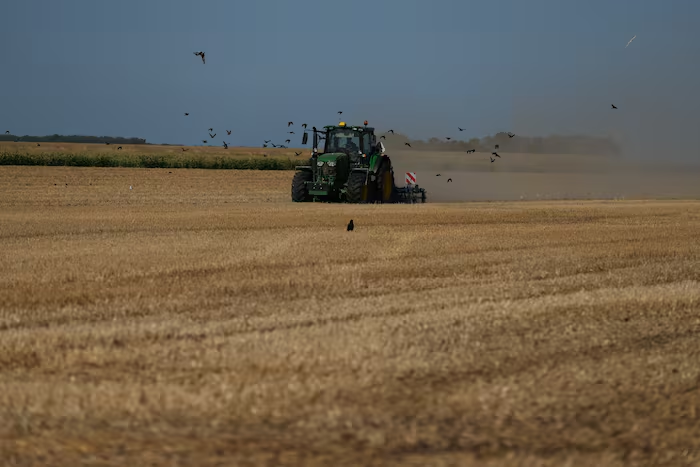
A punishing combination of extreme heat and severe water shortages is ravaging agricultural production throughout Europe, forcing farmers to confront crop failures and dwindling water reserves. The crisis, driven by accelerated climate change and a supersized El Niño weather pattern, is threatening food supplies and economic stability across the continent as the summer farming season reaches its peak.
In the Netherlands’ Zeeland Province, farmer Maarten Janse spreads nutrient-rich compost and manure over increasingly parched fields in a desperate attempt to improve soil resilience. Despite his adaptation efforts, the relentless combination of high temperatures, intense sunlight, and absent rainfall continues to devastate his crops, reflecting a pattern affecting growers from the Atlantic to the Danube basin.
An analysis released by Triodos, a Dutch sustainability-focused bank, estimates that ongoing heatwaves and drought conditions could reduce European Union gross domestic product by 1 percent in 2026, equating to approximately 180 billion euros or $208 billion. Farmers face the steepest losses, with agricultural regions across the bloc now experiencing restrictions on water extraction from natural sources for irrigation purposes.
Hendrik Jan ten Cate, another Zeeland farmer, observes his potato plants withering and ripening a month ahead of schedule while yields plummet dramatically. His potatoes typically supply major fast-food chains including McDonald’s, yet this year’s harvest is expected to decline by roughly one-third compared to historical averages, with individual tubers too small for commercial French fry production.
In Bosnia, where agriculture represents approximately 5 percent of annual gross domestic product and provides roughly 10 percent of employment, grain farmer Slavisa Lukic confronts catastrophic yield projections. His corn production is expected to drop from historical levels of 6 to 7 tons per hectare to just 1.5 to 2 tons per hectare, while clover crops have essentially vanished from the northeastern region’s landscape.
The drought’s impact extends to the Czech Republic’s celebrated beer industry, where Plzeňský Prazdroj, the nation’s largest brewer, anticipates significant financial losses due to severely reduced hop yields. Jakub Zaoral, the brewery’s sustainability manager, warns that unpredictable rainfall patterns—alternating between prolonged dry spells and sudden heavy storms—create runoff conditions that leave soil parched and groundwater levels dangerously low.
Romania’s grain transport infrastructure faces mounting pressure as record-low water levels on the Danube River restrict barge movement and create severe congestion at terminals. Cezar Gheorghe, founder of grain consultancy Agricolumn, reports that farmers are entering panic mode as harvest season approaches, with insufficient storage facilities for anticipated sunflower and corn production.
Hungary’s pastoral regions have transformed into dust bowls following five months without measurable rainfall, forcing dairy farmers to purchase expensive supplemental feed for livestock. Sándor Molnár, operating a dairy farm with 130 cattle, expresses cautious optimism while acknowledging years of similar challenges that have failed to resolve.
The Elveden Estate, an expansive 10,000-acre farming operation straddling the Suffolk-Norfolk border in eastern England, constructed two reservoirs to manage water scarcity, including one capable of storing enough water to fill approximately 200 Olympic-sized swimming pools. Despite this substantial infrastructure investment completed less than one year ago, the primary reservoir has nearly emptied, forcing farm management to carefully ration remaining supplies across a six-week window.
Janse employs conservation-oriented no-till farming practices combined with year-round soil cover crops to build resilience against extreme weather patterns. He has also diversified revenue through a campsite operation on his property and cultivates samphire, a salt-tolerant crop variety, though even this hardy plant cannot survive sustained drought conditions without freshwater access.

More Stories
Forest Service Proposes Steep Fee Increases at Lake Tahoe Recreation Sites
Son Discovers Father Missing After Himalayan Disaster in Nepal-Tibet Border Region
Month-Long HEPA Use Linked to Faster Cognitive Processing in Middle-Aged Adults