



💛 A quick favor, if you've got a second.
We're really happy that you chose to read one of our stories and sincerely hope you'll stick around to read more. We took our paywall down — for now — but that won't last forever, and when the gate goes back up, we'd love for you to already be on the inside.
It's free. So please enter your email here and don't forget to like and follow us on all of your favorite Social Media platforms!
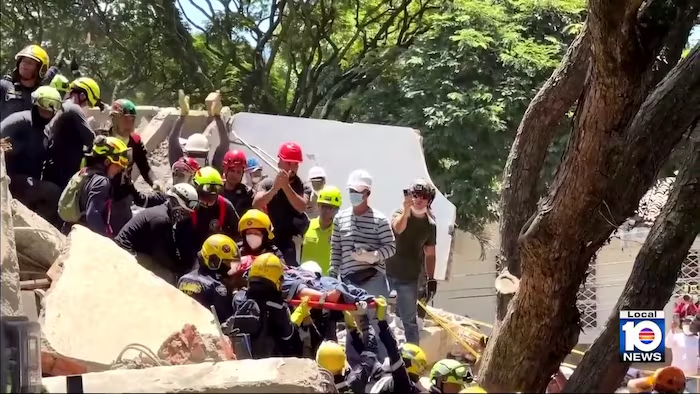
Search and rescue operations intensified across Colombia on Tuesday following a devastating 7.4 magnitude earthquake that struck the nation’s western region Monday, collapsing buildings and leaving thousands unaccounted for across multiple cities and rural communities. Heavy machinery and volunteer teams worked methodically through concrete debris and flattened structures, pausing periodically when rescuers believed they detected signs of survivors trapped beneath the wreckage.
President Abelardo de la Espriella reported at least 181 deaths and 2,595 injured from the disaster. The president acknowledged 195 officially missing persons, though civilian-operated databases indicate the figure could reach approximately 4,000, with significant uncertainty surrounding casualties in remote areas from which communication remains limited.
The most severe damage concentrated in Cali, Pereira, Manizales and Quibdo, though authorities expressed particular concern about rural communities inaccessible by conventional roads. The epicenter lay in Choco, one of Colombia’s poorest regions, where geographic isolation and conflict involving armed groups complicated rescue and assessment efforts. De la Espriella pledged that Choco would no longer be treated as a “land of the forgotten,” deploying military units, engineers and search dogs to affected areas.
Religious and environmental leader Sterling Palacios warned that comprehensive damage assessment could require weeks, noting that many towns remain reachable only by boat through jungle terrain. Armed group activity further impeded relief operations, as these organizations had previously restricted healthcare worker access during the COVID-19 pandemic.
Families desperately sought information about missing relatives through citizen-operated online databases. In El Cairo, a town near the epicenter where roughly 80 percent of structures sustained damage, resident Dana Carolina Zamora posted details about her missing uncle, a farmer living in a traditional dwelling. One woman was confirmed rescued alive from the rubble in Pereira, emerging to applause from observers.
The U.S. State Department committed $15.5 million in emergency assistance for shelter and food aid, while multiple Latin American governments offered support. The earthquake marked the first major crisis for de la Espriella, who assumed office days before the disaster, presenting a significant test of his leadership and ability to unite a politically divided nation during catastrophe.


More Stories
Colombia backs Trump security push while limiting U.S. role in anti-gang operations
Federal Prosecutors Convene Special Grand Jury to Investigate D.C. Schools’ Attendance and Graduation Practices
State Department Reissues Level 3 Travel Advisory for Israel Amid Terrorism and Armed Conflict Concerns