

💛 A quick favor, if you've got a second.
We're really happy that you chose to read one of our stories and sincerely hope you'll stick around to read more. We took our paywall down — for now — but that won't last forever, and when the gate goes back up, we'd love for you to already be on the inside.
It's free. So please enter your email here and don't forget to like and follow us on all of your favorite Social Media platforms!
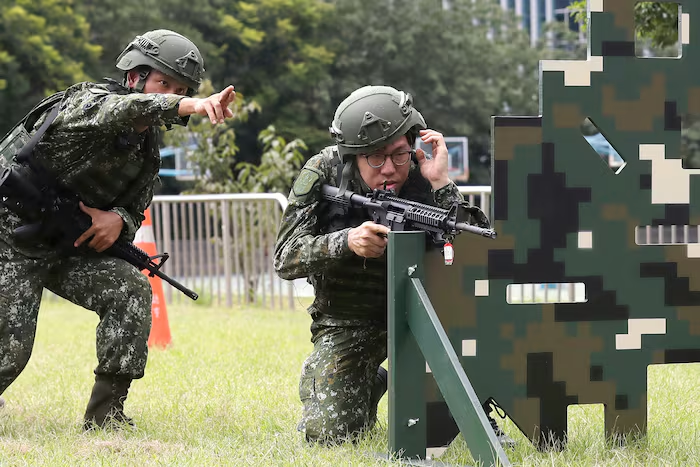
Taiwan launched its annual Huang Kuang military exercises Wednesday, with operations continuing through August 14 across multiple island locations. The drills prioritize demonstrating institutional resilience and adaptive defense capabilities rather than showcasing advanced weaponry, reflecting a strategic pivot in how the island approaches security challenges amid persistent threats from Beijing.
Military analysts attribute the exercise’s redesigned structure to increasingly visible coordination between Taiwanese and American defense forces. The drills prominently feature U.S.-style backbriefing communications protocols, where lower-ranking personnel brief commanding officers on tactical execution plans, a method designed to foster independent decision-making among frontline troops and strengthen overall combat effectiveness.
William Yang, a senior Northeast Asia analyst at the International Crisis Group, characterized the incorporation of American training methodologies as the year’s most significant development. He noted the exercises have shifted away from “mostly performative” weapons demonstrations toward building substantive operational capabilities within the Taiwanese military structure.
This year’s drills will mobilize approximately 20,000 reservists, among the largest numbers in recent years, underscoring Taiwan’s strategy to offset China’s military numerical advantage. Beijing maintains over 2 million active-duty personnel, roughly nine times Taiwan’s standing force, prompting the island to develop reserve mobilization capacity and civilian preparedness protocols.
Urban resilience exercises will occur in Kaohsiung, Taichung, and Taipei, with simulated telecommunications interference reducing mobile internet speeds for roughly 30 minutes to prepare civilian populations. These drills reflect longstanding Taiwanese civil defense priorities and align with President Lai Ching-te’s emphasis on comprehensive readiness given domestic political constraints limiting military spending.
Lai sought a $40 billion defense budget for American weapons procurement and domestic manufacturing, but Taiwan’s opposition-controlled parliament approved only $24.8 billion. Lev Nachman, a National Taiwan University political science professor, suggested the president has adapted his military strategy to work within political limitations while maintaining coordination with Washington.
Uncertainty persists regarding a $14 billion arms sales package awaiting President Donald Trump’s approval. Trump previously described Taiwan arms sales as negotiating leverage with Beijing and stated reluctance to deploy forces 9,500 miles to defend the island, creating anxiety about sustained American commitment.
Despite Trump’s equivocal public statements, the visible integration of U.S. military practices into Taiwan’s defense operations suggests underlying institutional continuity, according to analysts. Nachman characterized this military-to-military connection as a positive indicator that Taiwan continues receiving high-level training and strategic guidance from Washington regardless of political rhetoric.

More Stories
Colombia backs Trump security push while limiting U.S. role in anti-gang operations
Chicago Mayor Issues Executive Order Requiring Contractor Diversity Disclosures and ICE Ties Reporting
Federal Prosecutors Convene Special Grand Jury to Investigate D.C. Schools’ Attendance and Graduation Practices