

💛 A quick favor, if you've got a second.
We're really happy that you chose to read one of our stories and sincerely hope you'll stick around to read more. We took our paywall down — for now — but that won't last forever, and when the gate goes back up, we'd love for you to already be on the inside.
It's free. So please enter your email here and don't forget to like and follow us on all of your favorite Social Media platforms!
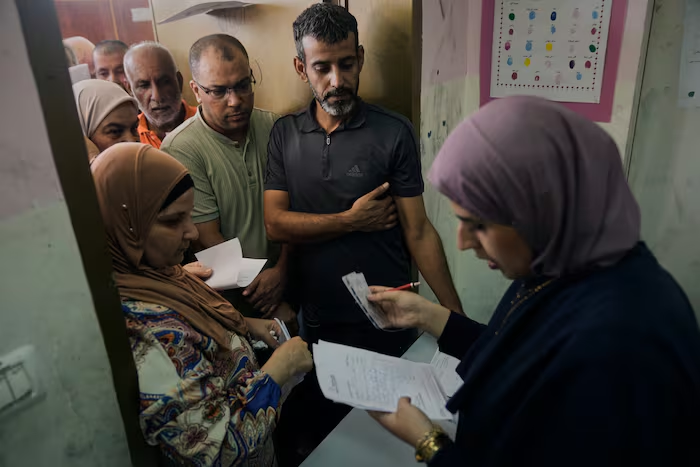
A human rights organization released a report Thursday documenting how Israeli policies have severely degraded healthcare delivery across the West Bank, leaving hundreds of thousands of Palestinians unable to access basic medical services. Physicians for Human Rights Israel warned that the territory’s health system faces an imminent collapse, with consequences that could prove life-threatening for vulnerable populations including cancer patients, the elderly, and those with chronic conditions.
Israel has withheld at least $2.5 billion in tax and customs revenues from the Palestinian Authority since 2023, according to the International Crisis Group. The PA, which administers parts of the Israeli-occupied West Bank, depends on Israel to collect these tariffs on goods entering through Israeli ports because Palestinians do not control their own borders. The funding freeze has forced the PA to slash spending on healthcare workers, medications, and hospital operations.
The impact on public health infrastructure has been severe, with 75 percent of public pharmacies, dispensaries and clinics now operating with reduced hours, functioning only once or twice weekly. Staff shortages have cascaded into delayed surgeries and routine procedures, while medication shortages have left patients like 70-year-old Bassam Musleh struggling for months to find prescribed heart medications. Palestinian Health Minister Majed Abu Ramadan said unpaid workers have stopped showing up, creating backlogs across the system.
Israeli military restrictions compound the healthcare crisis, as new checkpoints and roadblocks prevent Palestinians from reaching medical facilities. In July alone, at least two women gave birth in ambulances after checkpoints were closed, with one infant stillborn. Medical Aid for Palestinians documented three additional deaths this year, including two infants and a 30-year-old woman who suffered a fatal heart attack after an ambulance was detained at a checkpoint.
Aid organizations have attempted to fill gaps through mobile clinics and expanded services, but face their own constraints. Physicians for Human Rights Israel reported that patient volume at its mobile clinics doubled to approximately 500 daily over the past two years. However, Israel revoked licenses of more than three dozen humanitarian organizations earlier this year, including Doctors Without Borders, which subsequently halved its mobile clinic operations and reduced care access for more than 40,000 people.
The Israeli military has disputed allegations that it obstructs medical care, stating there is no intention to delay treatment or evacuations. Regarding the stillborn delivery near Nablus, the army said the ambulance had not completed required coordination before arriving at the checkpoint and that security screening lasted only minutes. Israeli Finance Minister Bezalel Smotrich and Prime Minister Benjamin Netanyahu’s offices did not respond to requests for comment.
Healthcare workers and patients describe the deteriorating conditions as psychologically devastating. At a mobile clinic in the West Bank village of Iktaba, Palestinians waited hours for treatment, with some breaking down emotionally. One patient, 65-year-old Asala Wawi, said the long wait times and overall crisis had exhausted her physically and mentally.

More Stories
Colombia backs Trump security push while limiting U.S. role in anti-gang operations
Modern Science Finally Supports & Strengthens Biblical Account of the Crucifixion of Jesus Christ
Federal Prosecutors Convene Special Grand Jury to Investigate D.C. Schools’ Attendance and Graduation Practices