

💛 A quick favor, if you've got a second.
We're really happy that you chose to read one of our stories and sincerely hope you'll stick around to read more. We took our paywall down — for now — but that won't last forever, and when the gate goes back up, we'd love for you to already be on the inside.
It's free. So please enter your email here and don't forget to like and follow us on all of your favorite Social Media platforms!
Tuesday’s election night defied conventional ideological divisions. Candidates from across the political spectrum won, and establishment figures alongside insurgent challengers claimed victory. The real pattern underlying these results had little to do with traditional left-right politics or insider versus outsider dynamics.
The fundamental distinction separating winners from losers centered on message clarity. Victorious candidates articulated straightforward, memorable statements about what they would accomplish. Defeated candidates relied on credentials, experience and electability arguments that failed to resonate.
In Michigan’s Democratic Senate primary, Abdul El-Sayed defeated Rep. Haley Stevens with a three-part message: “Money out of politics. Money in your pocket. Medicare for All.” Stevens countered with a case based on her experience and viability in a general election, an approach that centered on her career rather than voter concerns.
Missouri’s Democratic primary offered a similar dynamic. Former Squad member Cori Bush framed her race around billionaire interference in her district. Her opponent Wesley Bell reframed progressivism itself with six words: “Progressives are supposed to make progress.” Bell claimed a word Bush believed belonged to her and redirected it toward tangible results.
The 2016 presidential election illustrated this principle at the highest level. Donald Trump presented a simple three-part framework: China was taking jobs, he would bring them back; Washington had lost border control, he would build the wall; America had been diminished, he would restore it. This villain-action-benefit structure proved far more persuasive than detailed policy papers.
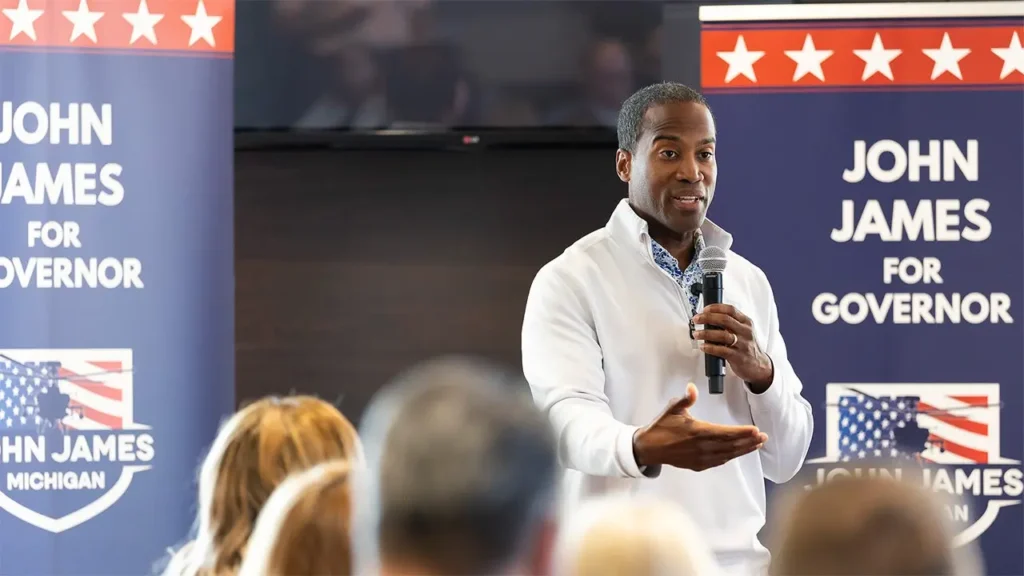
Michigan’s gubernatorial Republican primary showed similar patterns. John James emphasized restoration, work, security and Michigan’s comeback. Perry Johnson proposed a sweeping state government audit, a process-oriented message that lacked the emotional resonance of a tangible comeback promise.
Data center opposition emerged as an unexpectedly revealing issue. William Lawrence made this abstract artificial intelligence infrastructure question concrete by warning that families might pay more to power someone else’s data center. Translating distant policy concerns into kitchen-table economics proved effective.
Affordability has become the unifying language across recent elections, yet the concept only gains persuasive power when voters can visualize specific outcomes. A prescription filled, an avoided rent increase, a manageable utility bill—these concrete pictures move voters more than macroeconomic data.
Voters experience the economy as personal humiliations rather than statistical indicators. The grocery cart edited at checkout, the canceled dinner out, the permanently unaffordable home, the postponed medicine—these everyday realities shape electoral decisions more than aggregate economic figures.
Tuesday’s results also revealed that Americans simultaneously desire change and reassurance. They seek fighters and grown-ups, transformation and stability. This complexity confuses political professionals accustomed to neat ideological categories, yet voters remain fundamentally people rather than predictable data points.
The quality distinguishing winning campaigns was not uniformity in ideology but rather translation ability. Successful candidates transformed abstract ideology into visible outcomes, policy into pictures, political arguments into voters’ lived experiences. They positioned voters inside the story rather than asking voters to infer benefits from a candidate’s autobiography.
Effective campaigns begin with an understood “you” rather than “I.” Your money, your town, your family, your future—these frames prove stronger than lists of a candidate’s accomplishments. Every campaign should pass a second-person test: Can voters hear themselves in it? Can they explain what changes if the candidate wins? Can they repeat the central idea in ten seconds?
Tuesday night demonstrated a triumph of the personal over the procedural, the promise over the résumé and the memorable over the merely correct. Winners gave voters a sentence to remember. Losers gave them documents to read.

More Stories
Colombia backs Trump security push while limiting U.S. role in anti-gang operations
Former NFL cheerleader and ex-aide face off in close Rhode Island GOP primary
Chicago Mayor Issues Executive Order Requiring Contractor Diversity Disclosures and ICE Ties Reporting