



💛 A quick favor, if you've got a second.
We're really happy that you chose to read one of our stories and sincerely hope you'll stick around to read more. We took our paywall down — for now — but that won't last forever, and when the gate goes back up, we'd love for you to already be on the inside.
It's free. So please enter your email here and don't forget to like and follow us on all of your favorite Social Media platforms!
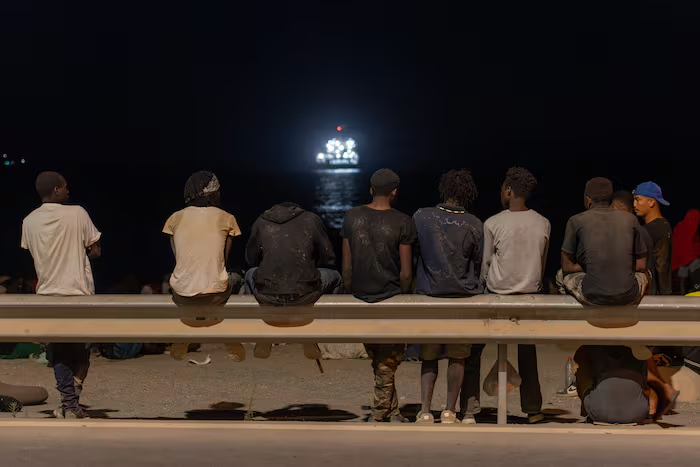
Spanish Prime Minister Pedro Sanchez came under intense fire from fellow European Union leaders Tuesday as the bloc convened to address last week’s sudden influx of migrants into the Spanish territory of Ceuta. Between Thursday and Friday, approximately 50,000 to 60,000 people attempted to enter the North African enclave, creating an immediate humanitarian emergency and reigniting divisive immigration discussions across the 27-member union. More than 80 people died in the chaos, with some drowning or being crushed during a stampede across a breakwater barrier, according to Spanish and Moroccan authorities.
Twenty-two EU leaders signed an open letter condemning Sanchez’s migration approach, while the Spanish premier responded with his own missive defending his government’s record. The exchange has crystallized a fundamental rift within the bloc between those advocating strict migration controls and Sanchez, whose progressive stance has challenged EU consensus on immigration, military spending, and Middle East policy. Sanchez’s administration characterized the attacks as politically motivated, asserting that authorities returned most migrants within hours through coordinated efforts with Morocco and minimal assistance from other European states.
The dispute reflects broader European fragmentation as the continent grapples with security concerns from Russia, uncertainty regarding U.S. relations, and economic competition from China, according to Alicia García-Herrero, chief economist for Asia Pacific and Middle East at Natixis. García-Herrero warned that Europe’s division signals vulnerability during a precarious geopolitical moment.
EU leaders blamed a Spanish Supreme Court decision requiring migrants arriving by sea to receive due process protections before deportation, distinguishing them from those crossing land borders or climbing barriers. Sanchez contended that human traffickers had deliberately misrepresented the ruling to encourage sea crossings around Ceuta’s fence. In his response letter, the Socialist leader reminded fellow member states that Spain had previously absorbed migrants from Belarus in 2021 and from Italy’s Lampedusa island in 2023 in displays of European solidarity.
Right-wing electoral victories across Europe have transformed migration policy, culminating in the adoption of the European Migration and Asylum Pact with stricter regulations replacing the previous framework widely deemed ineffective. The new rules grant EU capitals enhanced authority to monitor, detain, and return migrants to designated safe countries including Morocco, or to processing centers outside the bloc. Human rights organizations have expressed concerns that such foreign detention facilities could become permanent holding areas where asylum seekers languish in legal uncertainty.
Italian Premier Giorgia Meloni delivered the most pointed rebuke of Sanchez while announcing that Italy would implement additional air and sea border inspections with Spain. Analyst Matteo Villa of the Italian Institute for Political Studies in Milan suggested Italy faced minimal actual risk, noting that only 2 percent of European migrants ultimately reach Italian territory. Italy has leveraged the Ceuta incident to advance a controversial arrangement with Albania to relocate migrant screening procedures beyond EU borders.
Sanchez responded by characterizing Meloni’s position as incompatible with European law, humanitarian obligations, and collective solidarity principles. He further noted on X that Italy has admitted approximately twice as many migrants as Spain since 2021, receiving 478,000 people compared to Spain’s 234,000.
Migration flows to the EU have declined substantially from their 2015 peak of 1.8 million arrivals, with the first half of 2026 showing a 37 percent decrease to roughly 49,000 crossings, according to Frontex data. Hans Leijtens, Frontex’s executive director, attributed the reduction to sustained regional partnerships. European Commission President Ursula von der Leyen initially expressed concern about the Ceuta events while reinforcing the bloc’s restrictive migration stance, but subsequently sent Sanchez a letter Monday commending his crisis management and calling for strengthened external border protections.



More Stories
Former NFL cheerleader and ex-aide face off in close Rhode Island GOP primary
Trump Threatens FCC Action Against NBC’s Welker Over Endorsement Coverage
Chicago Mayor Issues Executive Order Requiring Contractor Diversity Disclosures and ICE Ties Reporting