



💛 A quick favor, if you've got a second.
We're really happy that you chose to read one of our stories and sincerely hope you'll stick around to read more. We took our paywall down — for now — but that won't last forever, and when the gate goes back up, we'd love for you to already be on the inside.
It's free. So please enter your email here and don't forget to like and follow us on all of your favorite Social Media platforms!
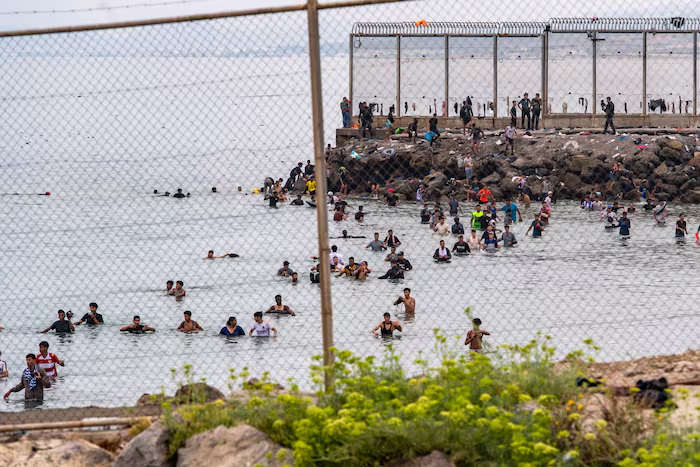
What began as unverified social media claims about a border opening snowballed into one of the largest migration surges between Morocco and Spain in recent years. Posts on Instagram, Facebook and TikTok suggesting Spain was permitting entry to its North African enclave of Ceuta prompted thousands of young Moroccans to make dangerous journey attempts within days. The viral misinformation campaign mobilized an estimated 60,000 people toward the border, fundamentally different from the typical scattered, smaller-scale crossing attempts that normally occur.
The initial spark came from an Instagram account called Haraga Ceuta, which shared videos claiming the border would open. Regional trains, packed buses and taxis filled with migrants heading toward the Moroccan city of Fnideq, the primary launching point for attempting the roughly 3-mile swim around the border breakwater into Spanish territory. Detailed TikTok videos mapped exact swimming routes, while Facebook groups like Fnideq Bab Sebta enabled users to share coast guard patrol tracking information and coordinate equipment purchases.
Chaos erupted when migrants reached Ceuta’s narrow concrete breakwater, where thousands attempted to scramble onto land simultaneously. Witnesses described people being pushed into the water and forced beneath others as the crowd surged forward. At least 72 people died on the Spanish side of the border, with an additional 11 fatalities reported on the Moroccan side, according to authorities. The stampede and drownings made this episode particularly deadly compared to typical migration attempts.
Some migrants had misinterpreted recent Spanish legal developments, including Prime Minister Pedro Sánchez’s immigration regularization measures designed only for individuals already residing in Spain prior to January 1. The policy, aimed primarily at Latin American residents who had overstayed their visas, became distorted in online discussions. Migrants incorrectly believed they would receive employment and residency documents upon arrival, a promise Sánchez never made.
Both Moroccan and Spanish authorities blamed human smuggling networks for orchestrating the crisis, yet returning migrants largely contradicted these claims. Most said they made independent decisions to cross after seeing online posts suggesting opportunity. Youth unemployment in Morocco stands at 37 percent among those ages 15 to 24, and nearly 20 percent among university graduates, fueling migration aspirations despite economic growth projections of 4.5 percent this year.
Moroccan Interior Ministry officials blamed the incident on “exploitation of the digital sphere” and “the spread of misinformation” but provided no supporting evidence. A Moroccan geographer specializing in migration noted the incident exposed broader security vulnerabilities at the border that both governments have yet to publicly acknowledge. Tens of thousands of migrants have since returned to Morocco voluntarily or after expulsion, though social media accounts involved in spreading the original claims were rapidly deleted.


More Stories
Modern Science Finally Supports & Strengthens Biblical Account of the Crucifixion of Jesus Christ
Federal Prosecutors Convene Special Grand Jury to Investigate D.C. Schools’ Attendance and Graduation Practices
State Department Reissues Level 3 Travel Advisory for Israel Amid Terrorism and Armed Conflict Concerns