



💛 A quick favor, if you've got a second.
We're really happy that you chose to read one of our stories and sincerely hope you'll stick around to read more. We took our paywall down — for now — but that won't last forever, and when the gate goes back up, we'd love for you to already be on the inside.
It's free. So please enter your email here and don't forget to like and follow us on all of your favorite Social Media platforms!
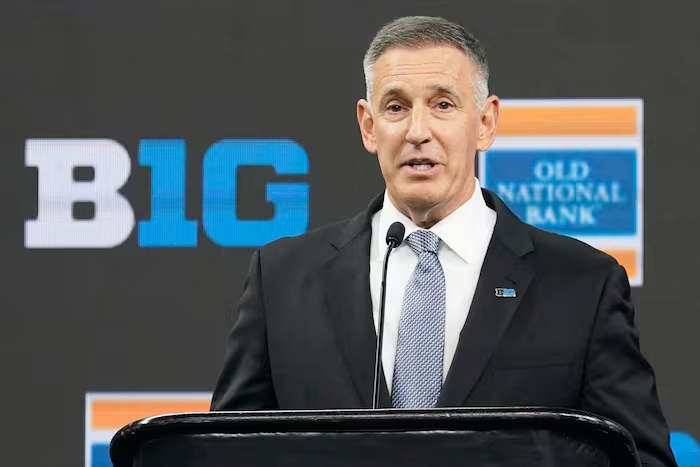
The Big Ten has signaled it will defer any changes to its nonconference scheduling requirements until the college football playoff expansion process reaches completion. Big Ten Commissioner Tony Petitti made the statement this week during the conference’s media days gathering in Chicago, indicating that scheduling policy decisions remain secondary to clarifying the postseason tournament structure.
The conference is actively lobbying for a 24-team playoff format to replace the existing 12-team system. Petitti explained that gaining clarity on playoff access and structure must precede any internal scheduling mandates, a position that resonates with many coaches and athletic directors throughout the league.
The Big Ten currently stands alone among major conferences in not requiring its schools to schedule at least one nonconference opponent from the Power Four grouping annually. This distinction has become increasingly notable as competing conferences have implemented such requirements, and the Big Ten’s own recent national championship teams—Michigan in 2023, Ohio State in 2024, and Indiana in 2025—all avoided nonconference regular-season matchups against Power Four programs.
Other Power Four conferences, including the Southeastern Conference, Atlantic Coast Conference, and Big 12, now mandate at least one nonconference game against a Power Four team or Notre Dame. The SEC and ACC are adopting nine-game conference schedules this year, eliminating the Big Ten’s previous justification that its nine-game slate provided sufficient competitive rigor.
Nebraska coach Matt Rhule and Northwestern’s David Braun expressed openness to a similar requirement, provided the Big Ten achieves its playoff expansion objective. “If we go into a 24-team playoff, it makes total sense,” Rhule said regarding mandatory Power Four nonconference scheduling.
Indiana coach Curt Cignetti predicted eventual standardization across conferences within two to three years. Several Big Ten programs currently lack Power Four nonconference opponents this season, including Nebraska, Penn State, Southern California, and Washington, alongside Indiana.
Big Ten coaches remain divided on whether mandatory Power Four scheduling represents sound policy. Minnesota’s P.J. Fleck endorsed the practice, citing competitive preparation benefits, while new Penn State coach Matt Campbell cited ongoing landscape uncertainty in declining to take a definitive position.


More Stories
Former NFL cheerleader and ex-aide face off in close Rhode Island GOP primary
University of Pennsylvania Climate Scientist Demands Supreme Court Packing Pledge From Democratic Candidates
Democratic Candidate Pia Dandiya Discusses House Race in District 22