


💛 A quick favor, if you've got a second.
We're really happy that you chose to read one of our stories and sincerely hope you'll stick around to read more. We took our paywall down — for now — but that won't last forever, and when the gate goes back up, we'd love for you to already be on the inside.
It's free. So please enter your email here and don't forget to like and follow us on all of your favorite Social Media platforms!
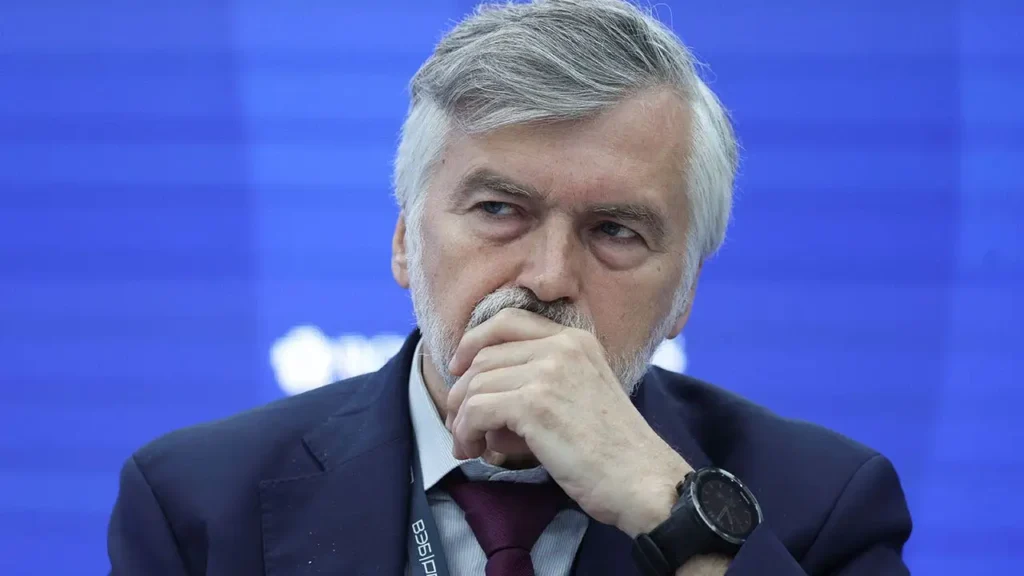
The dismissal of Andrei Klepach, chief economist at state development bank VEB.RF, has drawn international attention beyond routine personnel changes within Russia’s government apparatus. Klepach lost his position following public remarks in which he characterized Russia as trapped in an unwinnable “war of attrition” against Western economic pressure and predicted potential social upheaval. His firing underscores the critical question facing Western policymakers: whether sustained sanctions are finally constraining Moscow’s capacity to finance its military operations in Ukraine, or if Russia maintains sufficient resources to absorb ongoing costs.
Klepach, who had served as VEB’s chief economist since 2014 and previously spent a decade at Russia’s Economy Ministry, made his controversial statements at a May gathering of the Nikitsky Club, an assembly of economists, officials and academics. While his remarks were delivered in spring, they gained prominence in Russian media only the following week, prompting his removal from the position. VEB.RF acknowledged Klepach’s departure to Reuters but offered no explanation for the termination.
“We are falling behind. We are losing both the technological and economic competition in the world,” Klepach said during his address to the Nikitsky Club. He further noted that Russia was ceding ground not only to China and the United States but also to Ukraine, attributing Kyiv’s resilience to continued Western financial support and technical assistance.
Klepach warned that despite Russia’s demonstrated capacity to withstand sanctions, the mounting costs of the conflict combined with Ukrainian strikes on energy infrastructure and logistics networks were creating unsustainable economic strain. Russia’s central bank projected in July that economic growth could stagnate at zero percent for the year, while repeated attacks on refineries and industrial facilities have disrupted supply chains and elevated inflation pressures.
“We will not win the competition in this war of attrition,” Klepach stated, dismissing what he characterized as illusory beliefs that Ukrainian society would fracture. He predicted instead that Russia would experience widening economic degradation leading to potential social instability at an unforeseen moment.
However, a European intelligence official offered a contrasting assessment to Fox News Digital, distinguishing between Russia’s long-term economic trajectory and its immediate fiscal position. Higher oil prices have enabled Moscow to offset budget deficits more effectively, potentially affording the Kremlin additional operational flexibility before economic constraints force strategic decisions regarding the war effort. The official suggested that while fundamental economic challenges persist, Putin faces no imminent budgetary crisis that would compel withdrawal from Ukraine, potentially extending Russia’s capacity to sustain fighting through “another spring” or campaigning season.
The European Union intensified pressure on Moscow as these internal Russian debates unfolded. EU foreign policy chief Kaja Kallas announced plans for what she characterized as the “most far-reaching sanctions listings since the start of the war,” according to statements made to Germany’s Die Welt newspaper. Kallas stated that existing EU sanctions had already eliminated more than $1.16 trillion from Russia’s war economy.
EU diplomatic sources disclosed that the bloc’s foreign service plans to propose asset freezes, travel bans and transaction restrictions targeting approximately 1,600 additional Russian individuals and entities, with emphasis on military-industrial producers. EU governments will receive the proposed list in early September, with formal adoption targeted for October.
Within Russia, authorities simultaneously moved against opposition figures, sentencing Lev Shlosberg, deputy chairman of the Yabloko party, to 11 years and one month in a penal colony on charges of discrediting Russia’s armed forces and disseminating false information. Shlosberg maintained his innocence and characterized the case as politically motivated while repeating calls for a ceasefire. Russia’s Supreme Court had barred Yabloko from contesting parliamentary elections scheduled for the following month.
Military operations continued uninterrupted through the weekend into Monday. Russian forces struck port facilities in Ukraine’s Izmail district in the Odesa region overnight, damaging a Togo-flagged civilian vessel and wounding four individuals. Ukrainian drone operations killed a resident and struck industrial infrastructure in Russia’s Astrakhan region, according to the regional governor’s account.
ArcelorMittal reported that a Russian missile strike on its Kryvyi Rih steel manufacturing plant during the weekend killed two workers, injured three additional employees and contractors, and caused significant damage to energy and blast-furnace systems that partially suspended production operations.

More Stories
Federal voting arrest in New Jersey adds new pressure point in Sherrill-Trump standoff
Colombia backs Trump security push while limiting U.S. role in anti-gang operations
Former NFL cheerleader and ex-aide face off in close Rhode Island GOP primary