


💛 A quick favor, if you've got a second.
We're really happy that you chose to read one of our stories and sincerely hope you'll stick around to read more. We took our paywall down — for now — but that won't last forever, and when the gate goes back up, we'd love for you to already be on the inside.
It's free. So please enter your email here and don't forget to like and follow us on all of your favorite Social Media platforms!
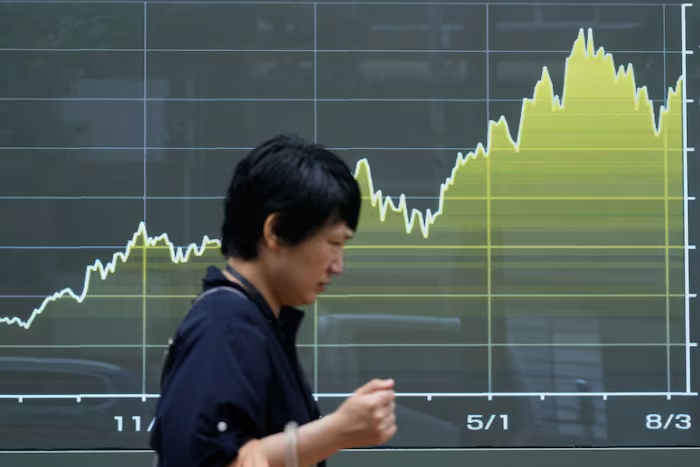
Regional equity markets across Asia moved higher Monday, building on weakness that gripped Wall Street following disappointing U.S. economic indicators released over the weekend. The pullback in American stocks came after data showed retail spending lagged expectations, raising questions about consumer resilience amid persistent inflation concerns. U.S. futures remained essentially flat in early trading, while crude oil fluctuated with no clear directional bias.
Japan’s Nikkei 225 index advanced 0.3% to close at 68,929.33 after government figures showed second-quarter economic expansion of 1.1% on an annualized basis, marginally outpacing initial forecasts. The modest quarterly growth rate of 0.3% masked underlying softness, as private consumption and capital investment remained stagnant while export momentum weakened. Hong Kong’s Hang Seng climbed 1.6% to 25,521.99, and Shanghai’s Composite index rose 0.8% to 3,960.19 in separate gains across mainland China.
Australia’s S&P/ASX 200 declined 0.4% to 9,076.90, bucking the regional uptrend, while Taiwan’s Taiex gained 0.5% and India’s Sensex fell 0.5%. South Korean markets remained closed for a holiday, limiting broader Asian participation in the day’s trading activity.
Friday’s U.S. market action saw the S&P 500 slip 0.2%, the Dow Jones Industrial Average dip 0.2%, and the Nasdaq composite retreat 0.3% following the retail sales report. Lower consumer spending could theoretically support the Federal Reserve’s case for maintaining accommodative interest rates, a development markets might otherwise welcome. However, the data simultaneously signals economic deceleration at a moment when inflation continues running well above central bank targets, creating the dreaded “stagflation” scenario of stalled growth paired with rising prices.
Major U.S. retailers will dominate earnings releases this week, with Home Depot reporting Tuesday, Target and Lowe’s on Wednesday, and Walmart on Thursday. These quarterly results will provide critical insight into how American businesses and consumers are navigating elevated price pressures and economic uncertainty. The Federal Reserve will release minutes from its July policy meeting Wednesday, offering additional context on the central bank’s monetary strategy.
In currency and energy markets, Brent crude edged up 0.1% to $88.62 per barrel while U.S. benchmark crude slipped 0.3% to $82.19 per barrel. Geopolitical uncertainty surrounding potential Iran nuclear negotiations and near-closure of the Strait of Hormuz continue to complicate the outlook for Middle Eastern oil and gas supplies. The dollar weakened to 159.09 Japanese yen from 159.32, while the euro strengthened to $1.1587 from $1.1588.


More Stories
Colombia backs Trump security push while limiting U.S. role in anti-gang operations
Chicago Mayor Issues Executive Order Requiring Contractor Diversity Disclosures and ICE Ties Reporting
University of Pennsylvania Climate Scientist Demands Supreme Court Packing Pledge From Democratic Candidates