
💛 A quick favor, if you've got a second.
We're really happy that you chose to read one of our stories and sincerely hope you'll stick around to read more. We took our paywall down — for now — but that won't last forever, and when the gate goes back up, we'd love for you to already be on the inside.
It's free. So please enter your email here and don't forget to like and follow us on all of your favorite Social Media platforms!
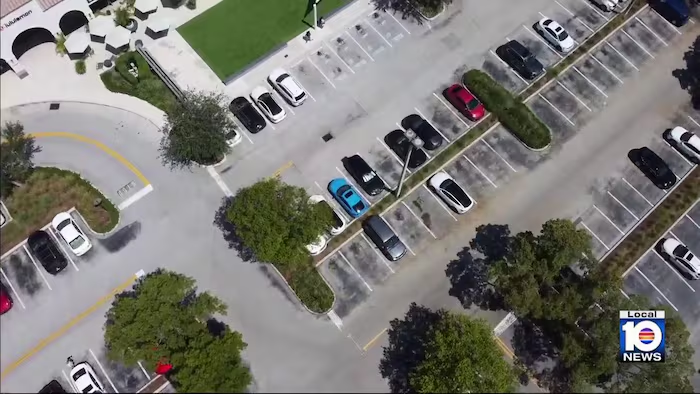
Authorities in Fort Lauderdale have removed individuals from a shopping center parking lot in the 2400 block of North Federal Highway where registered sex offenders and sexual predators had been staying under state supervision. During the enforcement operation, one person was arrested while others received trespass warnings, but officials acknowledge the deeper crisis driving such unauthorized encampments remains unaddressed.
The location had been previously approved by the Florida Department of Corrections as temporary housing for individuals with no legal alternatives, creating a standoff between local police, property owners who objected to the occupants, and state supervision authorities. When news media first reported on the site in June, multiple individuals under post-release supervision were documented living there in vehicles.
Florida law imposes sweeping residency restrictions on people convicted of certain sex crimes against minors under 16, barring them from living within 1,000 feet of schools, child care facilities, parks, and playgrounds. A 2026 law expansion added public swimming pools and public bathing facilities to the restricted-distance list, further narrowing available housing options for supervised individuals.
Municipal authorities in South Florida have added their own restrictions, including areas around school bus stops and transit benches. This layering of prohibitions has made legal housing nearly impossible to secure for many people released from incarceration, according to experts in the field.
Jeff Feldman, a former federal probation supervisory officer now working as a consultant, described the situation as a longstanding systemic failure. He said transient sex offenders have nowhere legal to live while probation agencies have nowhere to place them, a problem he traces back to 1997 when restrictive legislation began expanding.
Vanessa Fernandez, a licensed mental health counselor and clinical director at the Clinical and Forensic Institute, contends that housing instability undermines rehabilitation efforts. When individuals lack stable residences, treatment focus shifts to basic survival needs rather than reducing reoffending risk, she explained.
Probation officers face a practical dilemma: supervised individuals living in known locations can be monitored, whereas those in parking lots disappear from oversight entirely. Removing people from one site does not eliminate the restrictions that created the homelessness, leaving the underlying conflict unresolved.
The Florida Action Committee, which advocates for legislative reform of sex offender laws, filed a federal lawsuit this week challenging the constitutionality of residency restrictions. The group alleges that as many as 34 percent of registered sex offenders in Miami-Dade and Broward counties lack stable housing, though this figure represents a lawsuit claim rather than independent verification.
Experts disagree on whether restrictions enhance public safety. Some research suggests they do not meaningfully reduce reoffending and may actually increase risk by destabilizing living conditions and disrupting treatment. Neither the governor’s office nor the Florida Department of Corrections responded to inquiries about solutions.
Reformers like Feldman argue that rolling back some restrictive legislation could ease the housing crisis, but political obstacles remain significant. Policymakers hesitate to appear lenient on serious crimes, creating gridlock around meaningful legal changes that might ease the situation.
The parking lot where Local 10 found multiple individuals has been cleared, but authorities offer no answer about where those with no legal housing options are meant to reside. One man interviewed, Ivan Jones, expressed his grim assessment of available choices: sleep outside or return to incarceration.
More Stories
Federal voting arrest in New Jersey adds new pressure point in Sherrill-Trump standoff
Packers Running Back Josh Jacobs Placed on NFL Commissioner’s Exempt List Following Domestic Arrest
Federal Prosecutors Convene Special Grand Jury to Investigate D.C. Schools’ Attendance and Graduation Practices