

💛 A quick favor, if you've got a second.
We're really happy that you chose to read one of our stories and sincerely hope you'll stick around to read more. We took our paywall down — for now — but that won't last forever, and when the gate goes back up, we'd love for you to already be on the inside.
It's free. So please enter your email here and don't forget to like and follow us on all of your favorite Social Media platforms!
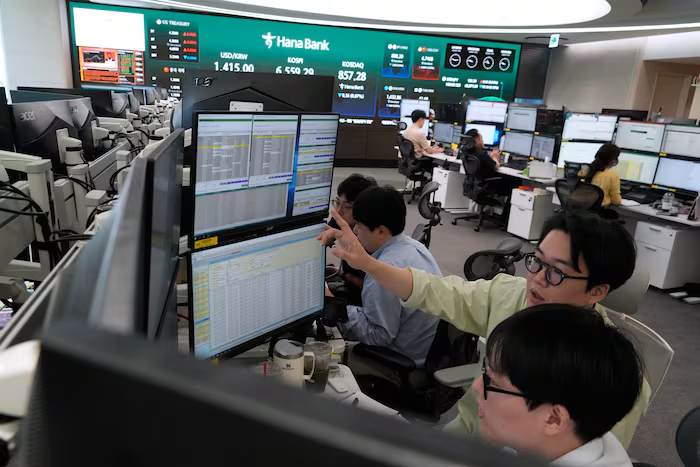
Major stock indexes across Asia posted gains Wednesday as regional investors showed renewed confidence in technology stocks, though U.S. markets retreated slightly from recent highs. The momentum came as crude oil advanced on persistent uncertainty about when Middle Eastern tensions might ease and allow petroleum supplies to resume normal flows.
South Korea’s Kospi index delivered the region’s strongest performance, jumping 4% to close at 6,597.90 as semiconductor companies attracted aggressive buying. Samsung Electronics surged 7.7% while memory chipmaker SK Hynix climbed 7.1%, driving much of the benchmark’s gains. Japan’s Nikkei 225 rose more modestly, gaining 0.6% to 67,334.94, while Taiwan’s Taiex advanced 0.8%.
China’s Shanghai Composite edged up 0.3% to 3,946.51, though Hong Kong’s Hang Seng declined 1.2% to 25,352.13. Australia’s S&P/ASX 200 fell 0.6% to 9,197.00, marking the region’s weakest performer among major indexes.
International benchmark Brent crude oil rose 0.9% to $89.67 per barrel Wednesday morning, while U.S. crude gained 0.9% to $83.98. Escalating geopolitical risks in the Middle East, including recent attacks by Iran-backed Houthi rebels on shipping vessels near Yemen, continued to pressure supplies and support prices.
Rising energy costs have pushed gasoline prices to $4.01 per gallon nationally, according to AAA data, up sharply from $3.14 a year earlier. The inflationary pressure has Wall Street focused on Wednesday’s release of monthly inflation figures, with economists forecasting a decline to 3.4% in July from 3.5% in June.
U.S. stocks declined Tuesday as investors digested economic data ahead of the inflation report. The S&P 500 fell 0.3% for its second consecutive modest loss following Friday’s all-time high, the Dow Jones Industrial Average dropped 184 points or 0.3%, and the Nasdaq composite sank 0.6%.
Lower inflation readings could ease pressure on the Federal Reserve to raise interest rates further, a move that would cool price increases but simultaneously weigh on economic growth and investment valuations. Treasury yields have climbed since February’s U.S.-Israeli strikes on Iran, with long-term mortgage rates reaching their highest levels in a year.
The U.S. dollar strengthened to 159.41 Japanese yen from 159.30 yen, while the euro weakened to $1.1535 from $1.1544.

More Stories
Colombia backs Trump security push while limiting U.S. role in anti-gang operations
Federal Prosecutors Convene Special Grand Jury to Investigate D.C. Schools’ Attendance and Graduation Practices
State Department Reissues Level 3 Travel Advisory for Israel Amid Terrorism and Armed Conflict Concerns