


💛 A quick favor, if you've got a second.
We're really happy that you chose to read one of our stories and sincerely hope you'll stick around to read more. We took our paywall down — for now — but that won't last forever, and when the gate goes back up, we'd love for you to already be on the inside.
It's free. So please enter your email here and don't forget to like and follow us on all of your favorite Social Media platforms!
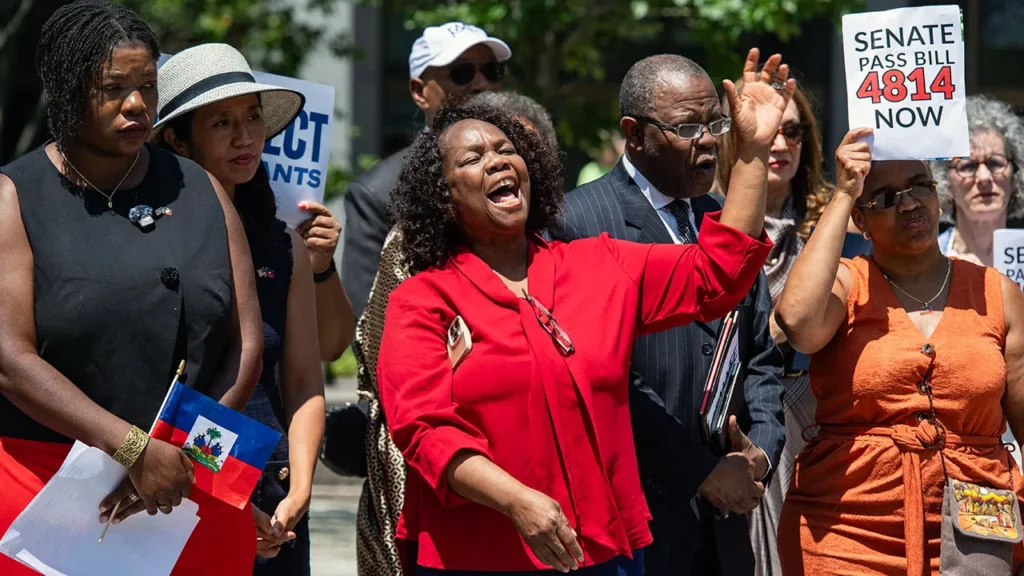
President Donald Trump secured a major immigration policy victory Wednesday when a federal judge acknowledged that a court order preventing the Department of Homeland Security from terminating temporary protected status for Haitians is no longer enforceable. U.S. District Judge Ana Reyes lifted the injunction following the Supreme Court’s ruling in Mullin v. Doe, removing the final judicial barrier to the administration’s termination decision.
The decision represents the resolution of a protracted legal dispute regarding the Biden administration’s expansion of Haiti’s TPS designation, an issue that became prominent during the 2024 presidential campaign. Trump and running mate JD Vance repeatedly cited Haiti TPS policies as contributing to increased Haitian migration to Springfield, Ohio, where they claimed migrants created public safety and service delivery challenges.
The controversy intensified after Trump invoked claims by Springfield residents that migrants were removing waterfowl from parks and consuming pets, assertions that drew national attention and became a centerpiece of immigration debate during the election cycle. Trump campaigned explicitly on reversing the Biden-era protections for Haitians.
Judge Reyes stated in her Wednesday order that the stay on DHS’s TPS termination “is no longer in effect” following the Supreme Court decision and the subsequent D.C. Circuit mandate. The administration is now free to proceed with ending protections for an estimated 330,000 to 350,000 Haitians currently residing in the United States, though the underlying lawsuit will continue.
The remaining litigation focuses on whether the administration acted with unconstitutional racial bias when terminating the designation. The Supreme Court ruled in June that the TPS statute precludes judicial review of non-constitutional termination decisions and determined that plaintiffs’ equal protection arguments were unlikely to prevail.
DHS General Counsel James Percival clarified that Haiti’s TPS status effectively ended July 27 when the Supreme Court issued its mandate, not with Judge Reyes’ Wednesday acknowledgment. Percival stated on social media that the judge’s order merely recognized that legal reality.
Haiti initially received TPS designation following the devastating 2010 earthquake and maintained the status through multiple administrations over 16 years. Former DHS Secretary Kristi Noem determined that Haiti no longer met statutory requirements for the temporary program, which she argued had extended far beyond its intended scope.
Following the Supreme Court decision, DHS announced that employment authorization documents issued under Haiti’s TPS designation would no longer be valid as of July 27, and employers were instructed to reverify work status for affected employees. The State Department currently maintains a Level 4 “Do Not Travel” advisory for Haiti due to gang violence, kidnappings and civil unrest.



More Stories
Federal voting arrest in New Jersey adds new pressure point in Sherrill-Trump standoff
Colombia backs Trump security push while limiting U.S. role in anti-gang operations
Former NFL cheerleader and ex-aide face off in close Rhode Island GOP primary