


💛 A quick favor, if you've got a second.
We're really happy that you chose to read one of our stories and sincerely hope you'll stick around to read more. We took our paywall down — for now — but that won't last forever, and when the gate goes back up, we'd love for you to already be on the inside.
It's free. So please enter your email here and don't forget to like and follow us on all of your favorite Social Media platforms!
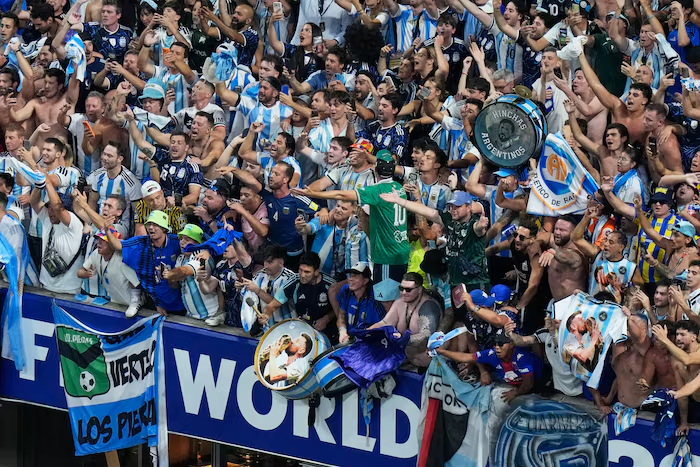
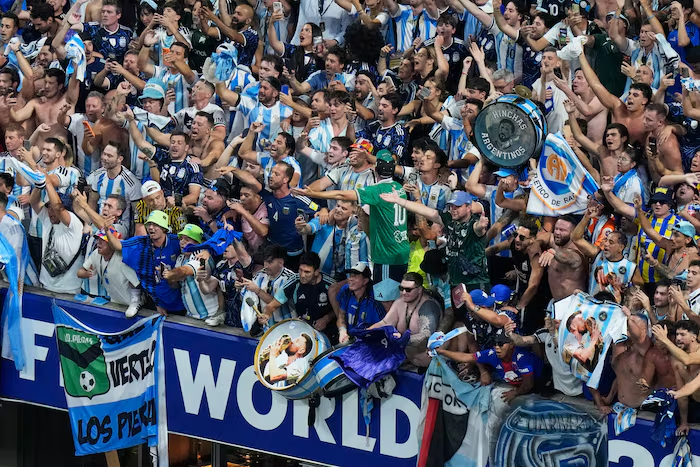
Thousands of international soccer enthusiasts traveled to American cities for World Cup matches, gaining firsthand exposure to American culture that extended well beyond the playing field. From regional fried chicken chains to sprawling retail destinations and consumer-focused infrastructure, visitors sampled quintessential American experiences that shaped their overall impressions of the nation.
Many foreigners arrived carrying preconceived notions shaped by international news outlets, social media algorithms, and indirect accounts of American life. These initial assumptions underwent significant transformation through direct interactions with American citizens and local communities across the country.
Visitor testimonies revealed a consistent pattern: Americans exhibited warmth and genuine approachability throughout their encounters. From Chicago to rural Arkansas to California and Texas, international guests consistently reported friendly greetings from strangers, attentive service from workers, and spontaneous invitations into local residences.
Sebastian Reader, 28, from London, organized his three-month American visit around England’s World Cup matches. While in Dallas, a restaurant acquaintance invited him to view a pickup truck and later welcomed him onto his porch for hours of conversation and refreshments.
Harry Gunns, also 30 and from London, discovered hospitality levels substantially surpassed his prior American visits. Service workers provided enthusiastic suggestions, and casual internet connections blossomed into dinner invitations from local families he had never previously met.
Gunns observed that the immediate sense of belonging distinguished American social patterns from British customs, which typically demand extended periods before integrating newcomers into social circles. The rapid acceptance he experienced surprised and delighted him throughout his stay.
Zineb Benlamlih, 28, from Morocco, unexpectedly joined a Manhattan dance group comprised of middle-aged New Yorkers without advance coordination. Such spontaneous moments of social integration characterized the American openness that traversed geographic boundaries.
Paradoxically, certain international visitors encountered Americans who either ignored the World Cup entirely or remained unaware of the tournament’s American host status. This widespread indifference proved shocking to foreign attendees who had invested substantial time and money for the experience.
Victoria Phillips-Hunter, a 34-year-old hospitality professional from Carlisle in northern England, departed for America carrying serious safety anxieties. Social media content depicting law enforcement actions and vehicle seizures had created considerable pre-departure concerns about her personal security.
Her actual experience contradicted these worries considerably. Phillips-Hunter praised American hospitality workers for their professionalism and expressed genuine interest in returning for future visits.
Multiple attendees emphasized that international criticism of America—frequently rooted in domestic political divisions amplified by global media coverage—bore minimal correspondence to their lived experiences. Gunns noted that some Europeans deliberately avoided American destinations for political reasons, yet found that actual Americans diverged markedly from their international reputation.
Gunns stated that his direct observations contradicted his prior reading material, noting that communities like those in Texas combined civic pride with authentic acceptance of international visitors. The disconnect between media narratives and personal experience struck him as particularly significant.
Benlamlih confronted immigration complications when associates from Chad and Somalia found themselves barred from attending due to American immigration restrictions. This situation underscored conflicting feelings about America’s soccer enthusiasm set against skepticism regarding U.S. immigration policies.
Rafal Kolankowski, a Polish native managing high school soccer programs near Pittsburgh, explained how international media representation diverges from what visiting foreigners actually encounter. He contended that global messaging about America frequently fails to capture the authentic experiences visitors have upon arrival.
Reader employed a deliberate strategy to maintain positive interactions: he systematically avoided political discussions. This conscious approach preserved harmonious exchanges during his cross-country travels, a perspective several American contacts independently affirmed as practically sound.

More Stories
Christa Pike Survives Botched Double Execution Attempt; Tennessee Halts Remaining 2026 Executions
Tennessee’s Lone Death Row Female is Scheduled for Execution Wednesday for 1995 Torture/Murder
Indiana coach Curt Cignetti tells restless Hoosiers fans not to gripe over 38-0 win