


💛 A quick favor, if you've got a second.
We're really happy that you chose to read one of our stories and sincerely hope you'll stick around to read more. We took our paywall down — for now — but that won't last forever, and when the gate goes back up, we'd love for you to already be on the inside.
It's free. So please enter your email here and don't forget to like and follow us on all of your favorite Social Media platforms!
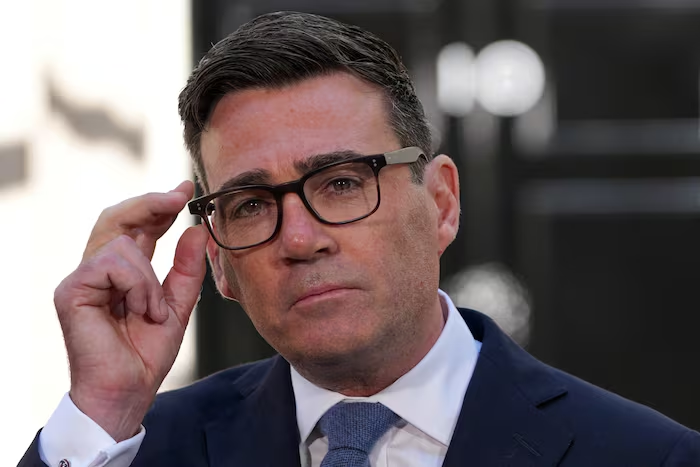
Andy Burnham assumed office as Britain’s prime minister facing a familiar yet formidable challenge: reviving an economy that has barely moved in more than a decade. His earliest policy announcements during his first day reveal the delicate political tightrope he must walk between providing immediate relief to struggling households and reassuring financial markets wary of reckless spending.
The Labour Party leader moved swiftly to signal fiscal restraint by appointing John Healey, a former Defense Secretary with Treasury experience under Gordon Brown, as his chief financial officer. Simultaneously, Burnham authorized the elimination of electricity taxes for households starting in October, a move designed to save the average family 45 pounds annually while emphasizing that the measure would be financed through cancellation of a planned digital identification program.
Burnham confronts the same economic puzzle that has defeated eight predecessors since 2008, each averaging just two years in office. Britain’s economy has expanded at a sluggish pace of less than 1.5 percent annually since the financial crisis, compared with 3 percent yearly growth in the 15 years prior. The government’s debt now exceeds 95 percent of gross domestic product, while interest payments on that debt consumed 111.2 billion pounds, or 8.3 percent of all government spending, in the fiscal year ending April.
A new complication arose when Burnham’s predecessor committed to raising defense spending to 3.5 percent of GDP by 2035, a pledge driven partly by pressure from U.S. President Donald Trump over NATO burden-sharing. Meeting this obligation will require roughly 36 billion pounds annually, equivalent to 500 pounds per British resident, according to the Institute for Fiscal Studies.
Without accelerating economic growth, the government must either impose tax increases or cut services including the National Health Service, a prospect that angers voters. Faster expansion would naturally generate more tax revenue without raising rates, since corporate profits, wages, and transactions would all expand. Yet Burnham has pledged to avoid raising taxes on working people and to maintain the “triple lock” on pensions, which guarantees annual increases tied to inflation, wage growth, or 2.5 percent, whichever is highest.
Burnham’s economic strategy centers on “reindustrializing” Britain by redirecting investment from London to regions devastated by manufacturing decline. He also aims to expand public housing construction to ease the nation’s shortage and support small and medium enterprises that employ 60 percent of the private workforce. However, policy specifics remain sparse.
Observers including Jim O’Neill, a former Goldman Sachs chief economist, have urged Burnham to pursue bold reforms rather than incremental adjustments. “We need somebody that’s prepared to do something bold and different,” O’Neill told the BBC, citing the need to address welfare spending and restrict growth in NHS costs. Economists warn that ignoring financial constraints imposed by bond markets would undermine any recovery effort, as investor confidence remains essential to fund government operations.

More Stories
Federal voting arrest in New Jersey adds new pressure point in Sherrill-Trump standoff
Colombia backs Trump security push while limiting U.S. role in anti-gang operations
Former NFL cheerleader and ex-aide face off in close Rhode Island GOP primary