



💛 A quick favor, if you've got a second.
We're really happy that you chose to read one of our stories and sincerely hope you'll stick around to read more. We took our paywall down — for now — but that won't last forever, and when the gate goes back up, we'd love for you to already be on the inside.
It's free. So please enter your email here and don't forget to like and follow us on all of your favorite Social Media platforms!
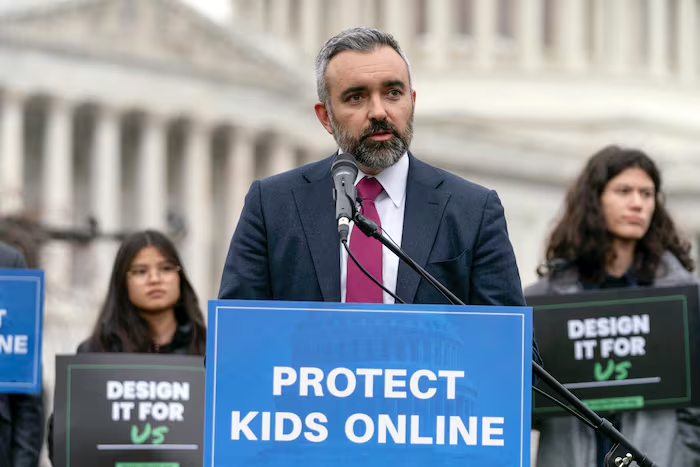
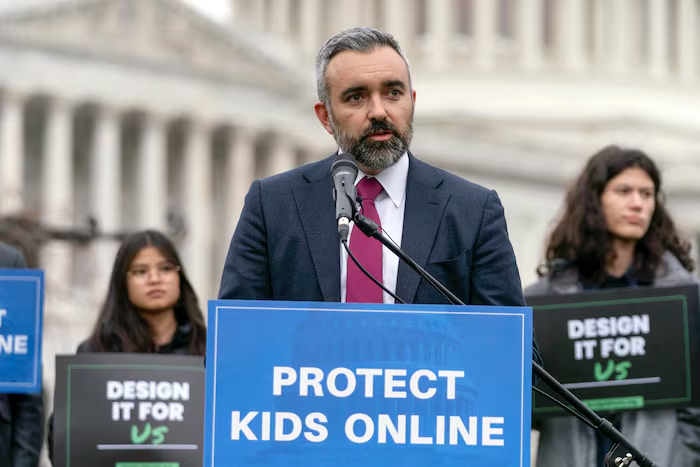
A New Mexico state court has ordered Meta Platforms to establish sweeping new protections for child users, marking what legal experts view as a significant moment in the broader regulatory battle over social media’s impact on young people. Judge Bryan Biedscheid’s Thursday ruling imposed a $567 million financial penalty and mandated operational changes including a 90-hour monthly usage ceiling for users under 18, restrictions on AI-powered chatbots, and conspicuous safety warnings displayed on Facebook and Instagram.
The decision emerged from the second phase of litigation initiated by New Mexico’s attorney general. It builds upon a jury verdict from March that found Meta liable for knowingly causing psychological injury to children while concealing information about child sexual exploitation occurring on its platforms. That earlier phase resulted in a separate $375 million civil judgment against the company.
Meta stated it maintains strong safeguarding practices and said it will contest the ruling in appellate proceedings. The company emphasized its commitment to online safety and noted the inherent difficulties involved in identifying and removing harmful actors and content from its services.
The court-ordered measures depend significantly on robust age-verification systems. Judge Biedscheid directed Meta to strengthen its age-assurance technologies and demand proof of age from users it suspects or knows to be under 13. Legal scholars acknowledge that while privacy-protective age verification is theoretically possible, implementation presents substantial practical obstacles.
Existing federal law creates additional complications. The Children’s Online Privacy Protection Act explicitly prohibits companies from collecting personal data from or passively monitoring users under 13, restrictions that could conflict with age-verification requirements even when ordered by courts.
Determining which users access platforms from within New Mexico presents another technical challenge, though experts suggest IP address tracking could provide a workable solution. Meta already operates Instagram Teen Accounts with built-in protections limiting peer contact and content exposure, along with parental controls for usage monitoring.
Advocates have praised the inclusion of judicial oversight in implementation. Brooke Istook, president and chief strategy officer of the Heat Initiative advocacy organization, emphasized that court-supervised enforcement allows officials to assess whether corporate modifications actually achieve protective goals and safeguard minors effectively.
Critics contend the ruling fails to address some of social media’s most problematic design elements. Features including autoplaying videos, infinite scrolling, and algorithmic content recommendations—widely acknowledged as drivers of compulsive platform use—remain untouched. Judge Biedscheid reasoned that restricting Meta’s features while competitors retain identical capabilities would unfairly disadvantage the company.
University of Pittsburgh psychology professor Sophia Choukas-Bradley expressed disappointment about the omission but endorsed several included protections, particularly the requirement that “like counts” remain hidden by default on minors’ accounts and measures preventing algorithmic promotion of child accounts to unconnected adults. She emphasized the necessity of combating documented cases of sextortion and online sex trafficking.
Questions persist regarding which specific design features most significantly damage adolescent mental health, according to Sonia Livingstone, a researcher at the London School of Economics leading the Digital Futures for Children initiative. She noted that while individual features may show modest effects in isolation, their cumulative impact creates the genuine concern for vulnerable youth.
The New Mexico-specific nature of the ruling has prompted concerns among legal professionals about fragmented state-level regulation. Former federal prosecutor Neama Rahmani, president of West Coast Trial Lawyers, warned that inconsistent state orders create operational chaos in an inherently national technology sector and argued that comprehensive federal legislation remains necessary.
Advocates now hope similar court victories across multiple states could catalyze congressional action on unified national protections. For New Mexico families, the ruling may alter household discussions about social media access, though parents recognize the ongoing tension between safety restrictions and adolescents’ desire for digital participation and peer connection.


More Stories
Federal voting arrest in New Jersey adds new pressure point in Sherrill-Trump standoff
Colombia backs Trump security push while limiting U.S. role in anti-gang operations
Former NFL cheerleader and ex-aide face off in close Rhode Island GOP primary