




💛 A quick favor, if you've got a second.
We're really happy that you chose to read one of our stories and sincerely hope you'll stick around to read more. We took our paywall down — for now — but that won't last forever, and when the gate goes back up, we'd love for you to already be on the inside.
It's free. So please enter your email here and don't forget to like and follow us on all of your favorite Social Media platforms!
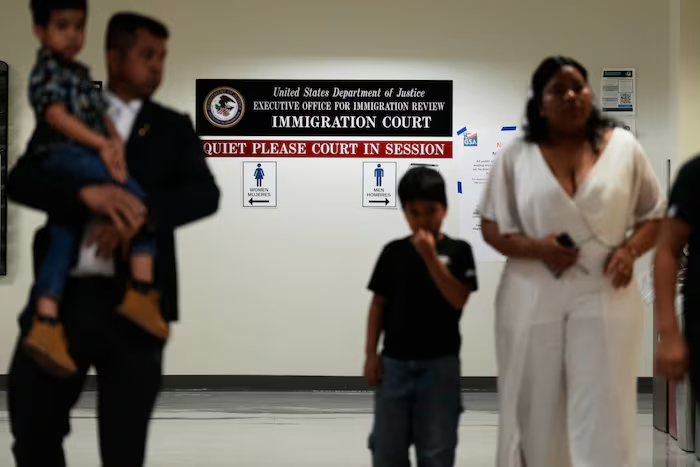
The Trump administration is rapidly scheduling immigration cases to address a decades-old case backlog, but the accelerated pace is generating a historic wave of deportation orders and no-shows. Data from Mobile Pathways, a nonprofit tracking immigration court proceedings, reveals that courts held more than 1,300 “mega” master hearings—sessions where judges hear dozens or hundreds of cases in a single day—in June alone, nearly triple the figure from June 2024.
Preparation time for complex immigration cases has collapsed dramatically, shrinking from approximately six months to little more than one month in many instances. This compression has coincided with a doubling of no-show rates, rising from roughly 20 percent in January 2025 to 40 percent by June, according to Mobile Pathways data. Individuals who miss hearings receive immediate deportation orders and their asylum claims are typically deemed abandoned.
Deportation orders have surged alongside the increased no-show rate, climbing from nearly 33,000 in January 2025 to approximately 79,000 by June. The rate of cases classified as abandoned is now nearly five times the historical average since 2009, with New York and Chicago experiencing rates roughly six times higher than historical norms. Once a deportation order is issued, immigrants lose virtually all avenues for appeal.
At a Harlingen, Texas immigration court, Judge Delia Gonzalez processed roughly 90 cases on a single day, with most hearings lasting under five minutes. More than 20 individuals failed to appear, and the judge lacked sufficient time to fully adjudicate remaining cases, requiring some who had waited over eight hours to reschedule. Immigration attorneys report caseloads have intensified dramatically, with one Texas-based lawyer handling nearly 20 cases in a single day, roughly 10 times his previous typical volume.
Conservative immigration policy advocates view the expedited hearings as necessary correction for a system that previously resolved few cases. Andrew Arthur, a fellow at the Center for Immigration Studies, acknowledged concerns that rapid processing could compromise judicial effectiveness or violate due process protections. The Justice Department’s immigration court office stated that judges are adjusting schedules to resolve cases efficiently while ensuring fair treatment under law.
Legal advocates argue the strategy is inherently flawed. Bartlomiej Skorupa, chief operating officer of Mobile Pathways, contended that compressed timelines combined with oversized hearing dockets effectively prevent meaningful case adjudication. “Valid claims are closed before being adjudicated,” Skorupa said, characterizing the schedule as designed to thwart proper case hearings.
The strategy has achieved measurable results on the backlog metric. Pending cases at the Executive Office of Immigration Review decreased from 3.7 million to 3.5 million during fiscal year 2025, marking the first decline in at least a decade. However, immigrant advocates maintain the cost to due process and accurate legal determinations is prohibitively high.



More Stories
Packers Running Back Josh Jacobs Placed on NFL Commissioner’s Exempt List Following Domestic Arrest
Federal Prosecutors Convene Special Grand Jury to Investigate D.C. Schools’ Attendance and Graduation Practices
Chicago Mayor Issues Executive Order Requiring Contractor Diversity Disclosures and ICE Ties Reporting