
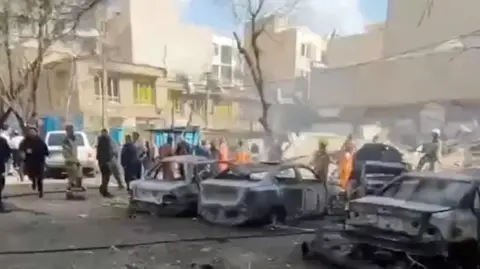
In the pre-dawn hours Saturday, a dramatic and unprecedented military operation unfolded that has reshaped the geopolitical landscape of the Middle East and reignited global fears of a broader war. The United States and Israel launched a coordinated attack on multiple locations within the Islamic Republic of Iran — a joint offensive striking Tehran and other key cities, marking the most significant military confrontation involving Iran and Western powers in decades.
The images that began circulating across global news wires were stark and unsettling: plumes of black smoke rising over Tehran, explosions trembling through urban districts, sirens blaring in Israeli cities, and the sound of missiles crossing borders in retaliatory strikes. For many outside the region, this moment was a sudden awakening to a conflict long simmering beneath the surface; for those within the Middle East, it is a cataclysmic escalation with roots stretching back years.
How We Got Here: From Tensions to Full-Scale Action
To grasp the full impact of the current attack, you have to trace the arc of Iran’s relations with Israel and the United States over recent years — a cycle of hostility, covert strikes, proxy wars, nuclear negotiations, and domestic unrest that built pressure toward an explosive breaking point.
A Long Road of Conflict
For decades, Tehran and Jerusalem have been cybersecurity enemies, bound by mutual fear and mutual distrust. Iran’s support for armed groups hostile to Israel — from Hezbollah in Lebanon to Houthi forces in Yemen — and its ballistic missile development have made it a central security concern for Israel and its Western allies. Likewise, the United States, for generations, has viewed Iran’s regional influence and nuclear ambitions as destabilizing and dangerous. These strategic concerns have played out in sanctions, diplomatic standoffs, and periodic military skirmishes.
In 2025, large-scale Israeli airstrikes targeted Iranian nuclear facilities in unprecedented fashion. That campaign sought to degrade Iran’s nuclear infrastructure, targeting Fordow, Natanz, and other enrichment sites — operations that elicited both strategic praise from allies and fierce criticism from opponents who warned they risked spiraling into deeper conflicts.
Meanwhile, domestic developments inside Iran added kinetic fuel to the geopolitical fire. Beginning in late 2025 and continuing into 2026, widespread internal protests erupted across Iranian cities, triggered by political repression, economic hardship amplified by sanctions, and growing public discontent with clerical rule. The government’s brutal crackdown on demonstrations — which independent rights groups say left thousands dead — intensified both domestic instability and international scrutiny.
The U.S. response to these protests and to Iran’s nuclear program involved both diplomatic pressure and an unprecedented buildup of military assets in the Middle East. In late January 2026, the United States deployed warships, air units, and missile defense batteries — the largest such buildup in the region since the 2003 Iraq War — signaling Washington’s readiness for possible confrontation.
With these factors aligned — strained diplomacy, rising internal dissent in Iran, a powerful U.S. military posture, and escalating Israeli fears about existential threats — the fuse for a confrontation was lit.
Here is President Trump’s complete and unedited eight-plus-minute speech, which was posted on Truth Social shortly after 2:00 AM EST, just over one hour after the first US/Israeli missiles began hitting targets throughout Iran (9:30 AM Tehran time).
Operation: Epic Fury
The name given to this stunning 2026 offensive — Operation Lion’s Roar (or “Epic Fury” in Pentagon sources) — captures both its ferocity and the psychological intensity of its goals. The operation is described as a coordinated military strike by the Israel Defense Forces (IDF) and the United States armed forces against strategic targets across Iran, including in and around Tehran.
The stated objectives from U.S. and Israeli officials were explicit:
-
Neutralize imminent threats to national security posed by Iran’s nuclear and ballistic missile programs.
-
Degrade the operational capacity of the Islamic Revolutionary Guard Corps (IRGC) and Iran’s conventional military strength.
-
Create conditions for internal regime change by encouraging Iranians opposed to their government to rise up.
President Donald Trump, in a post-strike video released on Truth Social, urged the Iranian people to seize the moment and “take over your government … it will be yours to take.” Israeli Prime Minister Benjamin Netanyahu echoed that message, framing the assault as a step toward enabling the brave Iranian people to shape their own destiny. It’s also interesting to note that Netanyahu’s version, which almost identically copied President Trump’s, was also broadcast in Farsi, the native language of Iran, throughout that country as he, like Trump, delivered a direct call to action for the Iranian people.
Targets and Strikes
While details are still emerging, several key elements of the offensive are already clear:
-
Missiles struck multiple sites in Tehran, including areas near offices associated with Supreme Leader Ayatollah Ali Khamenei.
-
Other cities across Iran were hit, including Isfahan, Qom, Karaj, and Kermanshah.
-
Reports — not yet independently verified — indicate that a compound linked to Iran’s leadership (described as Khamenei’s palace) may have been destroyed.
-
A strike in the southern city of Minab reportedly killed dozens of schoolchildren, a tragic figure that has already sparked international outrage and horror.
Explosions and conflagrations have lit up Tehran’s skyline, including the complete devastation of the home complex of Iran’s Supreme Leader, Ayatollah Ali Khamenei, though numerous cell phone video clips showed many Iranian citizens walking around rather nonchalantly throughout the carnage.
Tehran’s Response: Retaliation and Regional Fallout
As with the first echoes of gunfire in any large-scale war, the response from the Iranian leadership was swift. Within hours of the joint U.S.–Israel strikes, Iran launched ballistic missile and drone attacks targeting Israel and U.S. military bases scattered throughout the Gulf region. Countries like Saudi Arabia, Qatar, Kuwait, Bahrain, and the United Arab Emirates reported intercepting Iranian projectiles, while sirens continuously blared across northern Israel as air defenses were activated.
Most notably, Iranian missiles struck an empty warehouse on the U.S. naval base in Bahrain, underlining Tehran’s willingness to confront American military forces directly as part of its response. At the time of this writing, there have been no confirmed reports of serious casualties or fatalities as a result of any Iranian counterstrikes. And while Iran’s leadership has vowed a “crushing retaliation” and warned that no target — including American and Israeli assets — is off limits, Saudi Arabia has already declared that it will now enter the conflict, siding with the US/Israeli coalition, because Iran decided to fire missiles upon the US base located in Saudi Arabia.
Meanwhile, in Israel, millions of citizens, particularly in the more densely populated cities such as Tel Aviv, have taken to shelters in case some stray Iranian missiles happen to get through US/Israeli anti-missile defense systems whoch have, so far at least, been very successful in intercpting Irans retaliatory missile volleys.
International Reactions and the Global Stakes
As with virtually all issues on the global political spectrum these days, the world has watched this conflict unfold with a mixed bag of emotions that run the gamut from Patriotism, to alarm, and concern, sparking even more deep division than what already existed prior to this morning.
The Roots of Debate: Was This Avoidable?
Arguments about the war’s necessity — and its wisdom — are already raging.
Proponents’ View
Supporters of the operation argue that:
-
Iran’s nuclear program and missile capabilities posed an imminent threat to regional security.
-
Theocratic leadership in Tehran has consistently backed extremist proxies and destabilizing activities.
-
Previous diplomatic efforts failed, and military action was the only credible path to constrain Tehran’s capabilities.
Critics’ Perspective
Opponents — including voices in the U.S., Europe, and beyond — argue that:
-
The attack constitutes an unwarranted act of aggression that could draw the world into a larger, spreading war.
-
Military strike after military strike has failed to secure lasting peace or prevent Iran’s resilience.
-
A push for regime change from the outside rarely brings stability and often deepens the suffering of ordinary people.